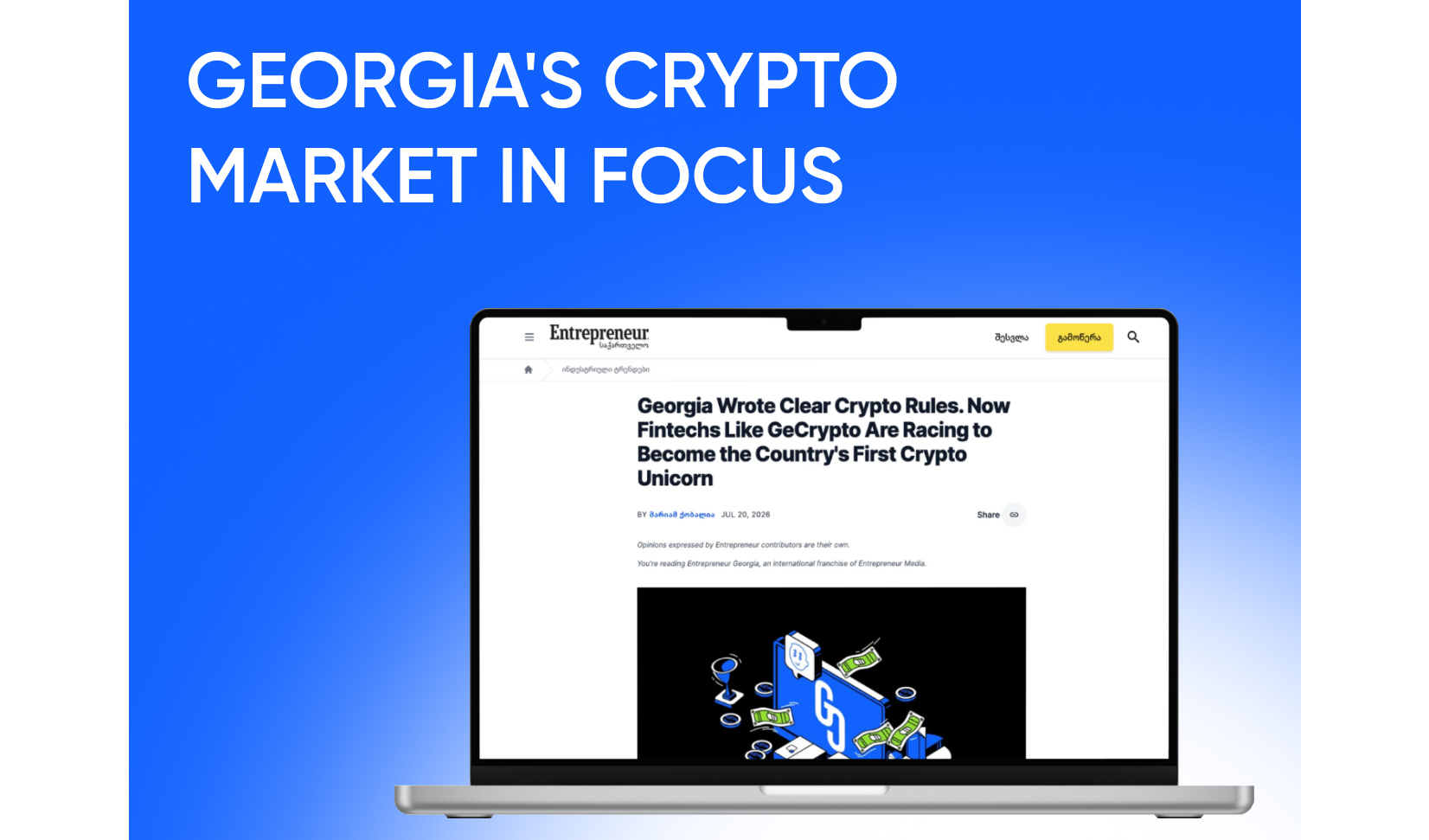
In July, Entrepreneur published a feature on Georgia's crypto market, with a substantial part of it devoted to GeCrypto: the author uses our story to show how licensing reshaped the industry. We covered the publication itself earlier. This time we go through its main arguments and add what the article's format left out: numbers, caveats, and details you only see from inside the market.
You can buy crypto anywhere. Spending it is another matter
The article opens with this observation, and it holds up. Owning digital assets is easy in most countries. The trouble starts one step later, when the asset needs to become a down payment on an apartment, an invoice paid to a contractor, or plain cash.
Georgia stands out on several counts at once. Chainalysis places the country among the world's top three for crypto adoption relative to population, alongside Ukraine and Moldova. The tax system runs on a territorial principle: income individuals earn from digital asset transactions is treated as foreign-sourced and exempt from personal income tax. One caveat the article skips: the exemption applies only to Georgian tax residents. If you are a tax resident elsewhere, your home country's rules still apply.
A telling detail from recent months: in late 2025 Bybit obtained a payment service provider licence from the National Bank, and in March 2026 launched a card in Georgia with Apple Pay support. The card is issued by the crypto platform itself, under a local licence, with no intermediary bank.
The paperwork matters more than the rate
The core argument of the piece. Before licensing, exchange deals happened in apartments and unmarked offices: no receipt, no way to prove where the money came from. The weakness of that model shows up not at the moment of the deal but later. A bank receiving a transfer from an unknown individual asks three questions: who is the counterparty, what is the purpose of the operation, and what documents confirm the source of funds. After a grey-market deal, there is nothing to answer with.
A licensed service settles all three questions in advance. The counterparty is a legal entity supervised by the National Bank, the rate is locked in the order, and every operation produces a document package that banks, accountants, and tax authorities accept. Yaroslav Bulatov, Head of Product at GeCrypto, put it briefly in the article:
"The paperwork is the product."
Behind the phrase is a routine process: every operation automatically leaves a trail nobody has to reconstruct a year later. We looked at how this works in practice in our guide to withdrawing crypto legally in Georgia.
The first to register were those who didn't treat the licence as a cost
The National Bank has supervised virtual asset service providers since July 2023. The requirements cover AML procedures, transaction monitoring, risk management, and a company's technological readiness. Part of the market saw all this as an expense and a reason to wait.
We took the opposite view: the application took us nearly a year to prepare, and in October 2024 GeCrypto entered the VASP register among the first, ahead of several international players. By Entrepreneur's estimate, within six months of licensed operation the company held around 20 percent of the domestic exchange market.
Clear rules attract investors, not just clients
In the article this point comes from Vlad Zhukov, an analyst at BR Capital: the Georgian market combines emerging-economy growth rates with rules you can actually read and apply.
This year's events back the observation up. In early 2026 the National Bank issued dedicated rules for fiat-pegged stablecoins: full reserve backing, reserves held separately from company funds, minimum capital of 500,000 lari. In May, Tether and the government announced GEL₮, a stablecoin pegged to the lari, with Prime Minister Irakli Kobakhidze presenting the project. The regulator was quick to add a clarification: private stablecoins will not gain the status of official legal tender, which stays with the lari. In parallel, the National Bank continues its digital lari pilot built on Ripple technology.
For an investor, the sequence reads one way: the country is regulating not just exchange but the next layer of infrastructure, and doing it ahead of demand rather than after the fact.
The licence turned out to be an entry ticket, not a finish line
The final argument of the piece concerns trajectory: from an exchange office to a fintech company. Part of that road is already behind us. GeCrypto clients receive payouts in dollars, euros, and lari to accounts at Georgian banks, and international transfers run over SWIFT, SEPA, and ACH.
Entrepreneur looks at all this from altitude and talks about a regional hub and the race for the country's "first crypto unicorn." Our view is simpler: clients at the Marjanishvili office and online, a locked rate, and a document package with every deal. Both pictures describe the same process, just from different distances.