In Tbilisi, the address goes a long way toward setting the price. A new-build apartment in Vake costs about 1.7 times as much as an identical one in Samgori[1].
Georgian citizens buy around 90% of apartments in the city[2]. Local demand sets prices, and in a few years whoever rents or buys your apartment will most likely be local too. If you are planning to buy an apartment in Tbilisi, look at the districts through residents' eyes: what they value in each one and what they are willing to pay for.
What a square meter costs in each district
Tbilisi has ten administrative districts. In Q3 2026, new-build prices in the most expensive district were almost double those in the cheapest: GEL 7,004 per square meter in Mtatsminda versus GEL 3,657 in Samgori. Apartment prices across the city rose 5.6% year on year.
Fewer new buildings are on the way. Between January and May 2026, the floor area of housing approved for construction fell 34% compared with the same period of 2025[3]. Established districts have little vacant land left, so the slowdown in construction helps keep prices firm.
New-build prices per square meter by Tbilisi district, Q3 2026
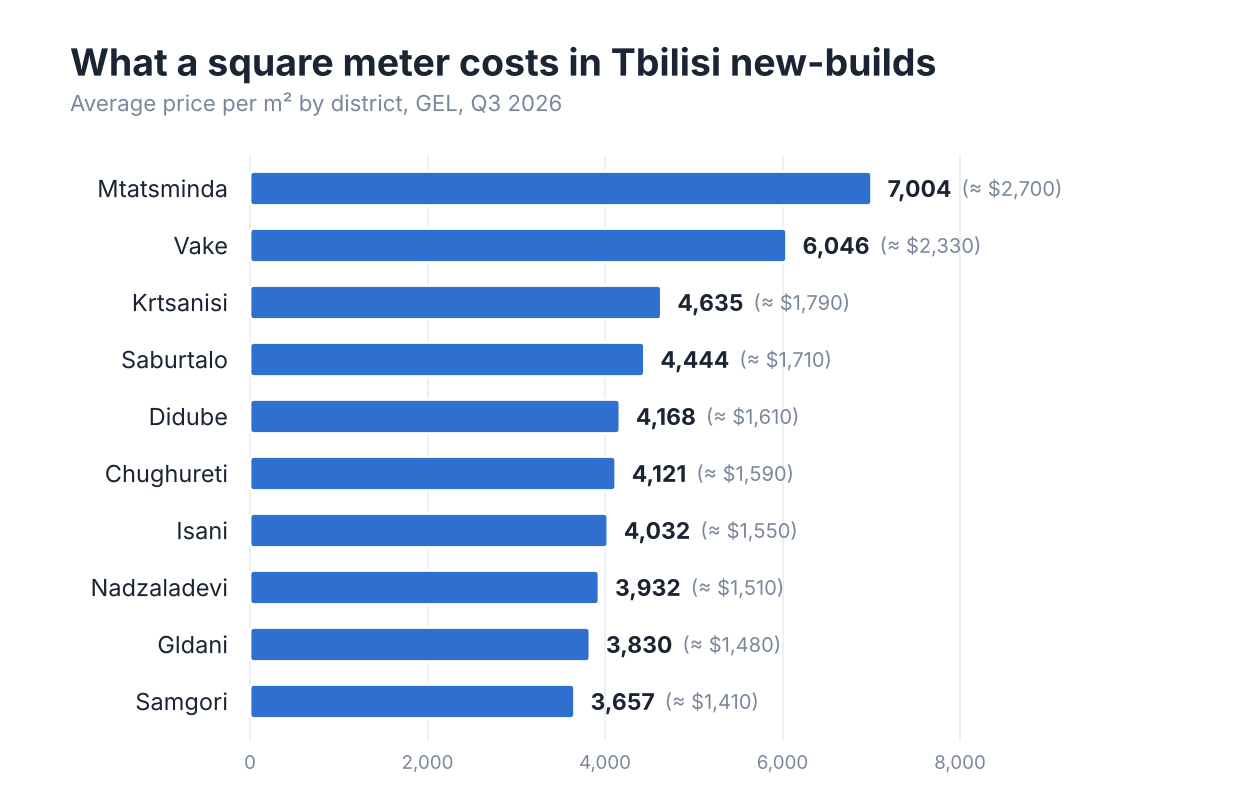
Two caveats apply to the chart. First, it covers new-builds only; apartments in Soviet-era buildings are cheaper, especially in the outer districts. Second, these are district averages: an individual building can be priced above or below them, and asking prices usually leave room for negotiation.
Vake: top prices and almost no land left to build on
Vake has almost no vacant land left. Buyers mostly choose between apartments in buildings from the 1950s to the 1980s and the occasional high-end development squeezed in among them. New-builds in Vake cost about a third more per square meter than those in Saburtalo. The premium reflects scarcity, since few apartments come up for sale and demand stays high.
Families near Vake Park rarely move, and good apartments often change hands by word of mouth or through agents without ever appearing on listing sites. If you are set on Vake, find a local agent early and give them a detailed brief.
In an older building, check the elevator, the state of the stairwell and whether any changes to the layout were officially approved and registered. In a new development, ask what is planned for the neighboring plot. Vake is densely built, and a new tower across the street can block the view you paid for.
Old Tbilisi: Sololaki, Mtatsminda, Vera and Avlabari
Mtatsminda has the highest average new-build price in the city, even though most of its housing dates from the 19th and early 20th centuries. New developments on the hillsides and near Rustaveli Avenue push the average up. Prices for older apartments vary widely, often depending on the condition of the building.
In Sololaki and Vera, buyers look for apartments with high ceilings, wooden balconies and Italian-style courtyards. Across the river in Avlabari, similar housing costs less. Old Tbilisi is the part of the capital most popular with tourists, so many buyers plan to let their apartments short term.
Older housing comes with its own risks, and you need to know about them before paying a deposit:
Some buildings are protected as heritage sites, so the facade, windows and layout cannot be changed without approval.
Pipes and wiring in these buildings are long past their service life, courtyards are shared, and any repairs have to be agreed with the neighbors.
Extensions, enclosed balconies and attic conversions are not always registered with the Public Registry, so the official floor area may differ from the actual one.
Saburtalo: popular with buyers and tenants
Saburtalo is the district buyers ask about most. New-build prices per square meter sit between those in the center and those on the outskirts. With universities and office buildings nearby, there is always someone looking to rent. Small apartments rent quickly to students and office workers, which also makes them easier to sell on to another investor.
New buildings are going up along Vazha-Pshavela Avenue, Pekini Avenue, Bakhtrioni Street and in the blocks between them. Residents complain about the density (on some streets the towers stand two rows deep), rush-hour traffic and the lack of courtyard parking.
In Saburtalo, the building matters more than the address. The distance to the nearest tower, parking, access to the main road and which floor the apartment is on all shape its price and how quickly it finds a tenant.
Didi Dighomi and Lisi: new neighborhoods without a metro
Didi Dighomi draws buyers to new neighborhoods where schools, kindergartens and shops are built alongside the housing. Both Didi Dighomi and Lisi are administratively part of Saburtalo district, so there are no separate price statistics for them. Even so, apartments in Didi Dighomi are clearly cheaper than in the older part of Saburtalo. Lisi, with its low-rise developments and detached houses around the lake, is quieter and pricier than Didi Dighomi.
The two share one main drawback: the metro doesn't reach them. Only one or two main roads lead to the center, and they clog up at rush hour. A family with a car will miss the metro less, but these apartments are harder to let to students.
Krtsanisi and Ortachala: the riverside south
Krtsanisi is rarely counted among the city's upmarket districts, yet by average new-build price it ranks third, behind Mtatsminda and Vake. The figure is driven by a gated enclave of villas and new developments along the Mtkvari River. Until recently, neighboring Ortachala was a stretch of industrial riverfront. Its warehouses are now giving way one by one to residential developments a few minutes from Old Tbilisi.
Some industrial plots remain next to the new buildings, so find out what is planned for them before you sign.
Didube and Chughureti: close to the center at outer-district prices
Prices per square meter in Didube and Chughureti are close to those in Isani, even though Rustaveli Avenue is only a few metro stops away. Since its restoration, Aghmashenebeli Avenue in Chughureti has seen cafes, hotels and offices open, and the area has started to attract tenants. In Didube, new housing is going up on former industrial sites. Both districts have downsides, though: noisy main roads and aging pipes and wiring in older buildings.
Isani, Samgori, Gldani and Varketili: the most affordable housing in the city
These districts have the lowest prices in Tbilisi, with new-builds in Samgori costing about 40% less per square meter than in Vake. If you want to buy an apartment in Tbilisi on a budget, this is the place to start looking. Most of the housing dates from the Soviet era, but many new buildings have gone up between the old blocks in recent years.
Demand in these districts is closely tied to the metro, which runs out to Varketili and Akhmeteli Theatre. Apartments near the stations rent steadily to local tenants. That makes these districts a practical option for an investor with a modest budget who is counting on long-term rentals.
Building condition varies a great deal, and a renovated nine-story block can stand next to one whose roof has never been replaced. Compare listings within the same neighborhood, because a sizable price gap between adjacent buildings usually comes down to their state of repair.
New-build or Soviet-era resale
In Tbilisi's newer buildings, developer prices and resale prices have almost converged. In May 2026, apartments bought directly from developers averaged $1,412 per square meter, compared with $1,366 in completed new buildings[3]. The gap is small, and a finished building lets you judge the structure, the neighbors and the build quality before you buy.
New-builds in Tbilisi are sold at different stages of completion. "Black frame" means a bare shell: walls and floor slabs with no finishing. "White frame" adds plaster, screed, wiring and plumbing. "Green frame" means the apartment is ready for the final finish. The less finished the apartment, the lower the price per square meter, but you then have to pay for the fit-out and wait for it to be completed. Buying off-plan is also cheaper because the buyer takes on the construction risk, so vet the developer especially carefully.
Resale apartments in Soviet-era buildings cost less than new-builds, and their prices depend heavily on the state of the interior. In the outer districts, apartments with dated interiors are listed about 20% below freshly renovated ones; in central districts the gap is 10–15%[4]. Most Soviet-era buildings are in Vake, Vera, Isani, Gldani and Varketili. Buyers favor what locals call "Czech project" buildings for their practical layouts and 1950s buildings for their high ceilings, while Khrushchev-era blocks sell for less. Before buying in a Soviet-era building, find out when the roof and the water risers were last replaced and whether the courtyard has parking.
The residence permit threshold: how many square meters $150,000 buys
An apartment in Georgia can qualify you for a temporary residence permit if its market value exceeds $150,000. The threshold was raised from $100,000 in spring 2026. Our guide to Georgia's residence permit in 2026 covers who qualifies, for how long and what the permit gives you. This section looks at how many square meters that money buys in different parts of Tbilisi.
At the average new-build price per square meter and the current lari exchange rate, it works out like this[5]:
Mtatsminda: about 56 m²
Vake: about 64 m²
Saburtalo: about 88 m²
Gldani: about 102 m²
Samgori: about 106 m²
In Vake, a mid-sized apartment of around 65 m² is enough to qualify. In Saburtalo, you would need close to 90 m², and in the outer districts more than 100 m². A typical small apartment doesn't reach the threshold in any district. These figures are based on district averages, while the permit depends on the appraised value of the apartment itself, which may be higher or lower.
Buyers from abroad rarely keep a sum of this size in a Georgian bank account. The money is more often held in a foreign bank or in USDT, and transfers from some countries take weeks or are not possible at all. For this reason, funds for an apartment purchase are often sent to Georgia via crypto.
GeCrypto is registered with the National Bank of Georgia as a virtual asset service provider, registry number 0018-9404. Our office is at 5 Kote Marjanishvili Street in Chughureti. After the exchange, you can collect US dollars in cash at our office or have the money transferred to your own account at a Georgian bank and pay the seller from there.
FAQ
How much does a one-bedroom apartment cost in Tbilisi?
A new-build apartment of about 45 m² costs an average of $63,000 in Samgori, $77,000 in Saburtalo and $105,000 in Vake. An apartment of the same size in a Soviet-era building will cost less.
How much does a two-bedroom apartment cost in Tbilisi?
For 65–70 m² in a new-build, expect to pay 90,000–105,000 in Samgori and Gldani, 110,000–120,000 in Saburtalo and 150,000–165,000 in Vake. Prices for individual apartments can differ considerably from the district average.
Which Tbilisi district is best for buying to let?
For long-term rentals, buyers usually choose Saburtalo, Chughureti and Didube, as well as outer districts close to metro stations. For short-term lets to tourists, Old Tbilisi works best. Citywide, long-term rentals yield about 8.4% a year on average[3]. The return on a given apartment depends on the purchase price, the cost of renovation and how many months a year it stands empty.
What should I check in the Public Registry extract before buying in Tbilisi?
Three things: who is registered as the owner and whether that matches the seller; whether there is a mortgage, a court-ordered seizure or any other encumbrance; and what floor area is recorded. If the seller is acting under a power of attorney, check that document too before paying a deposit.
[1] Geostat, Residential Property Price Index for Q3 2026: average price per square meter of new-build housing by administrative district of Tbilisi.
[2] Colliers Georgia estimate, 2026.
[3] Galt & Taggart, Tbilisi residential real estate update, May 2026.
[4] Tbilisi Home, listing prices for Q3 2026.
[5] National Bank of Georgia official rate on October 29, 2026: GEL 2.5957 per US dollar.