
The peak of foreign arrivals in Georgia came in 2022, and that is when most of the relocation guides still circulating on blogs, forums and chat groups were written. They were put together in the moment by people going through the procedures themselves, which makes them detailed and convincing. Their single problem is age: several years have passed since.
The country has changed noticeably in that time. Between the last two censuses the population of Tbilisi grew by 223,000 people, a rise of 20%, while Batumi added more than half again. Where cities grow that fast, housing prices, bank requirements and residence rules move with them.
The rules have moved furthest of all. They were revised four times over the past year, and the central change is that the right to stay in the country and the right to work in it now sit in separate documents. Someone who arrived visa-free and works exactly as they did a year ago is in a different legal position today, without having changed anything in their own life. Below we go through it in order: what changed and when, what grounds people stay on, how to open an account, what taxes are due and how to bring savings over.
What changed in 2026
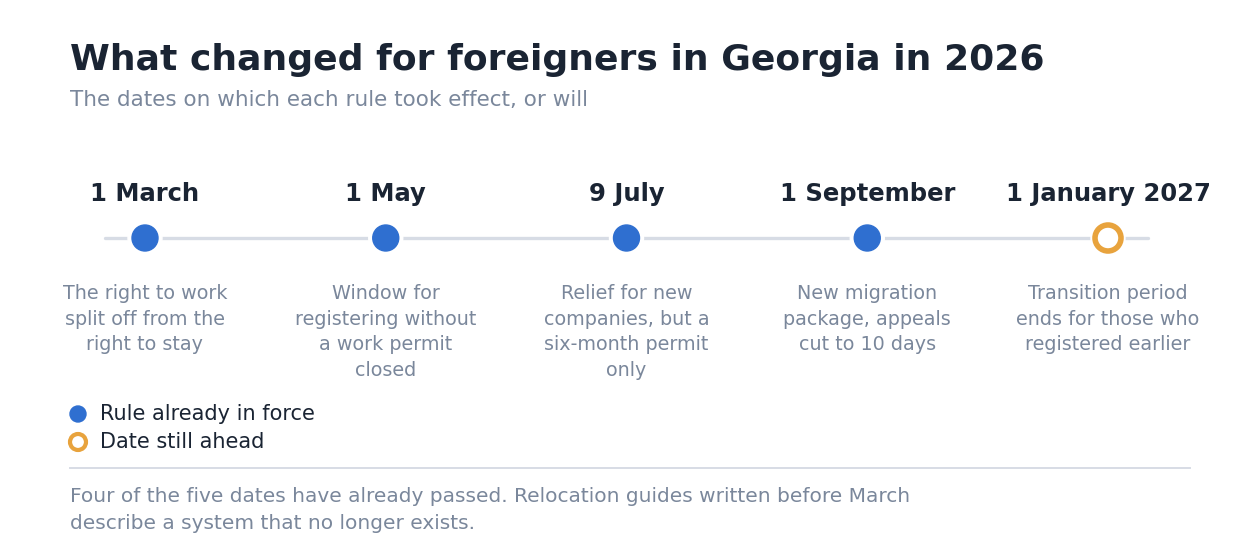
The changes came in waves through the year, and several of the deadlines have already passed.
1 March. Work and business activity began to require authorisation: either a work permit or a suitable residence permit. On the same day the property investment threshold for a residence permit rose from 100,000 to 150,000 dollars.
1 May. The transition period ended, during which penalties for working without authorisation were not applied. The window that allowed registration under the old, simpler rules closed.
9 July. A government decree introduced relief for new businesses. A company less than three months old with no more than three foreign employees does not confirm its turnover on a first application. The permit issued this way runs for six months only, and the turnover figures will still be needed at renewal.
1 September. A package of migration rules took effect. Study permits were revised, spouses of Georgian citizens were given a separate residence permit instead of a direct route to permanent residence, the window for appealing a refusal was cut to 10 calendar days, and a D6 visa category appeared.
Separately from these dates came a medical insurance requirement: cover of at least 30,000 lari is now asked of everyone entering the country.
How the rules for foreigners in Georgia changed in 2026
Entry and how long you can stay
Visa-free entry is open to citizens of roughly 95 countries and territories, among them the United States, Canada, the United Kingdom, EU member states and the Gulf countries. The permitted stay is the same for everyone, up to 365 days. By world standards that is a great deal: most countries cap a visa-free visit at three months.
What matters, though, is that the right to stay in the country and the right to work in it now exist independently of each other. Visa-free entry gives you a legal year in Georgia, but on its own it gives you no grounds to work for a Georgian employer or to run a business here.
The question we are asked most often is about remote work for clients outside the country: does it count as work under the new rules. There is no direct answer in the guidance. The requirement is written around activity with a Georgian connection, and freelancing for clients abroad landed in neither column, permitted or prohibited.
There is little sense in waiting for that to be clarified. Most new arrivals take a simpler route: they register as an individual entrepreneur and apply for small business status. The rate under it is 1% of turnover, as long as annual revenue stays below 500,000 lari. Registration is done at the Public Service Hall, a standard application costs 26 lari and is ready the next working day, an express one costs 75. Small business status applies from the date the request is filed, so income earned in the current month already falls under the reduced rate.
Check your line of business in advance. The reduced rate is closed to licensed occupations, and also to legal, medical, audit, notarial and consulting services.
The rate is not the only reason to open an IE, and often not even the main one. What helps more frequently is that you acquire a documented income. You will be asked for it at the bank when opening an account, at the migration service when applying for residence, by a landlord signing a year-long lease, and at a consulate when applying for a visa to a third country. Without it, every one of those conversations starts with explanations, and they do not always work.
Note the main limitation. Since March, registering as an IE is not enough on its own. You need to obtain the right to work alongside it, and the next section covers how that is arranged. Without that document, registration does not close the question.
What to do when the visa-free year runs out
There are two routes. Either you obtain a residence permit, or you leave the country and enter again.
Residence permit through work or business
What it is for. This permit covers both cases, employment and your own business activity. It is the one people obtain alongside IE registration to gain the missing right to work. For employment you will need a contract with at least six months left to run, and the employer confirms annual turnover of at least 50,000 lari per foreign employee, with a lower threshold of 35,000 for medical and educational organisations. The employee shows income of at least 1,500 lari a month.
How long for. The first permit runs from six months to a year, and is renewed after that. In total you can live on a work permit for up to 12 years, and after 10 continuous years of residence the route to permanent residence opens.
Residence permit through investment
What it is for. An investment of at least 300,000 dollars in a Georgian enterprise.
How long for. Five years straight away, and this is the fastest legal path to permanent residence: you can apply after five years rather than ten. The permit extends to the applicant's spouse and minor children.
Residence permit through property
What it is for. Property worth at least 150,000 dollars, registered in the applicant's own name and confirmed through the register.
How long for. Six months to a year on the first application, renewed after that. Keep the tie to the asset in mind: sell the property and the permit is cancelled along with it.
Residence permit through study
What it is for. Enrolment at a university or vocational institution. Since September this route no longer works for school pupils.
How long for. For the duration of the programme. New grounds for losing the status early have appeared as well: absence from the country for more than 183 days in 12 months, failing to earn more than a third of the annual credits, or a suspended student status left unresolved for more than 90 days.
Residence permit through marriage or family
What it is for. Marriage to a Georgian citizen, or family ties to someone who holds residence or citizenship here. Since 2021 the circle has been narrowed to spouses and minor children.
How long for. The spouse of a citizen receives a separate permit for one year, renewable for two, with the whole route capped at five years. In exchange, after five years of marriage and residence in the country permanent residence opens up, twice as fast as the general term.
Visa runs instead of a permit
Your permitted stay is counted from the date of your last entry, not cumulatively across the year. Leave and come back, and the counter starts again at 365 days. The practice exists in many countries, but in Georgia it is arranged more comfortably than anywhere else in the region. In the Schengen area you have to leave every 90 days out of 180, which means four trips a year at minimum. Here one trip a year is enough, and not a long one: the Armenian border at Sadakhlo is about two hours by bus from Tbilisi, the Turkish one at Sarpi about an hour from Batumi on a city bus.
There is no minimum time you must spend abroad, formally it is enough to cross the border and return, and there is no cap on how many visa runs you make. The decision, though, is taken by the border officer on the spot, and a refusal can follow from an overstay of even a single day, a passport with less than 90 days of validity left, missing medical insurance and so on. The list of grounds for refusal also includes the wording "other cases", which can be stretched to cover anything, and each successive visa run draws more attention.
How to open a Georgian bank account
Where to go. Accounts for foreigners are opened by Bank of Georgia, TBC, Liberty and Credo. Liberty usually replies within a day or two, the larger banks take longer, and with additional checks the process stretches to two weeks.
What to bring. A passport, a completed application form, proof of your source of income, a local SIM card, a rental agreement and a clearly stated purpose for the account. The order matters here: the SIM card and the lease are arranged before the bank visit, otherwise the application will not be accepted at all.
Why applications are refused. Banks have tightened their checks under pressure from international regulators. Failing to follow procedure threatens their correspondent relationships with Western financial institutions, and international transfers are impossible without those, so everyone is cautious. A refusal is almost never about the passport in itself. It comes down to risk factors: an unclear source of income, no confirmed address in the country, signs that the account will be opened and abandoned.
The practical conclusion follows from that. The bank needs to understand two things: where the money will come from and what the account is for. Someone with a specific answer along the lines of "day-to-day expenses and rent" and documents in hand gets through quickly, while a vague "financial transactions" triggers an in-depth review.
An open account immediately gives you a legal route for money that is still held in crypto. A licensed exchanger credits the payout as an ordinary bank transfer, one that has a sender, a stated purpose and a full set of documents for the deal. How that works is covered just below.
Taxes: what you pay and on which income
Two opposite myths circulate about Georgian taxes. The first says there are no taxes here at all, the second warns that a resident pays on worldwide income. Both are wrong.
Residency. You become a tax resident if you spend 183 days or more in the country within any 12 consecutive months.
Foreign income of an individual. The key point of this whole section: income of an individual from a foreign source is not taxed in Georgia, and becoming a resident does not change that. It sounds too good, which is why you will find the opposite claim online. Check your own situation with an adviser, but the general rule is exactly this.
Rates. Income tax is 20% and applies to income from a Georgian source. Dividends from Georgian companies are taxed at 5%. Pension contributions are mandatory for citizens and permanent residents, and foreigners are exempt from them.
Small business status. An individual entrepreneur with annual turnover below 500,000 lari pays 1% of turnover instead of income tax. The status is not available to those providing legal, medical or notarial services.
Reporting. The annual return is filed by 1 April of the following year, and small businesses report monthly by the 15th.
Crypto for individuals. A resident's income from crypto transactions is treated as foreign income and exempt from tax, and no VAT is charged on such transactions. Companies and entrepreneurs running crypto activity as a business fall under the ordinary regime.
How to bring your savings over
For most people who relocate, the money stays where they came from, and the question of moving it comes up in the first weeks. In Georgia, transactions with virtual assets are legal, the market is regulated by the National Bank and providers operate under licence.
The hard part of moving savings does not lie in the transfer itself. It lies in giving the money a history. A bank receiving a large payment, a notary at a property purchase, the migration service reviewing a residence application will all ask sooner or later where the funds came from. That question is put to everyone, it is a routine part of compliance, and what separates people is not whether it gets asked but whether they have an answer ready.
After a deal through a licensed exchanger, there is one. You are left with a contract, a receipt and a bank statement showing the incoming payment, and that set closes the question in any of the situations above. We have written a separate piece on exactly what a bank looks at when funds arrive from an exchanger. After a transfer with no history behind it, there is no answer, and it surfaces at the worst possible moment, when the money is needed urgently.
We at GeCrypto have been working in Georgia since 2022 under a National Bank licence, and have grown into the country's largest OTC desk: more than 10,000 active clients and a 4.9 rating on Google Maps from over a thousand reviews. Our fees are low, and we build no hidden markup into the rate.
We keep a single office, in central Tbilisi on Kote Marjanishvili Street, but we serve clients across the country, and our support speaks Russian, English and Georgian. You can collect cash dollars from us, send money to a Georgian bank account in lari, dollars or euros, or make an international transfer via SWIFT, SEPA or ACH. Deals start at 100 dollars and have no practical upper limit, so a one-off move of savings and regular exchange are both handled in one place.
Your first weeks: the order of things
The steps below come in the order they actually line up, and the order matters more than the speed.
1. Choose a city. Tbilisi, Batumi and Kutaisi offer three different ways of living and diverge noticeably on costs, infrastructure and seasonality. We have put all three side by side, with rent figures, in a separate article.
2. Rent a place and get the agreement. The lease is needed for more than living somewhere; the bank will ask for it.
3. Get a local SIM card. Without one neither a bank application nor registration with most services will go through.
4. Open an account. Come prepared: documents on your source of income, the lease, a specific purpose for the account.
5. Settle your grounds for staying. Count the days from the date you entered and work out in advance what you will be staying on once the visa-free year is up.
6. Sort out money for the first months. Move your savings in a way that leaves you with documents once the deal is done.