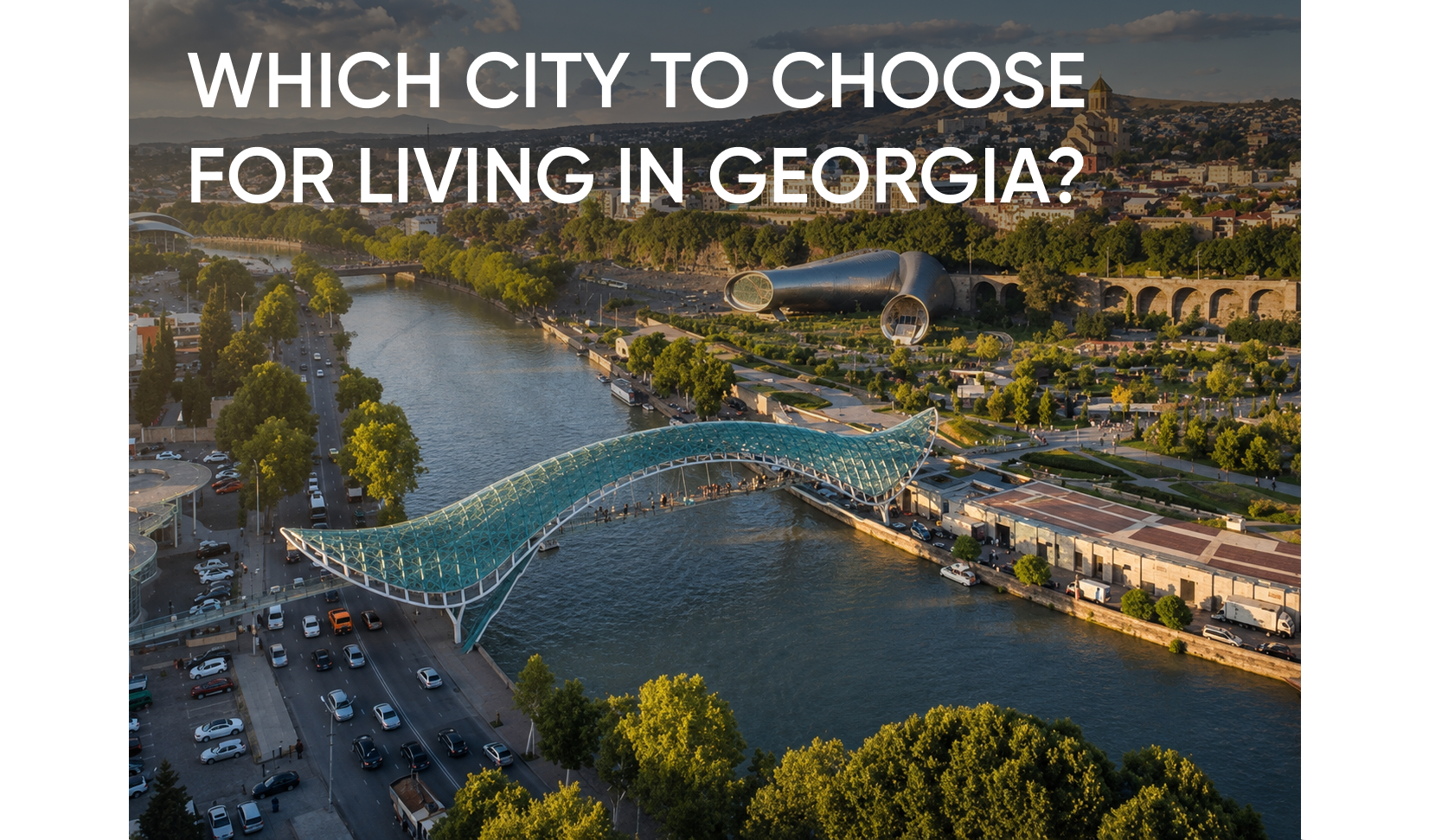
People usually decide to move faster than they decide where to move. The country is picked, the timing is clear, and then you open the map and see three names that come up in almost every conversation: Tbilisi, Batumi, Kutaisi. Judging by photographs, the difference between them comes down to whether there is a sea. In practice it runs deeper and shows up in your costs, your daily routine and how easily ordinary things get done.
Who moves to Georgia, and on what terms
The latest census counted 133,857 foreign nationals living in Georgia permanently. Entry rules here remain unusually relaxed: citizens of roughly 95 countries and territories, including the United States, the United Kingdom, EU and Gulf states, can stay for up to a full year without a visa.
The largest foreign communities in the country:
Russia: 37,715 people. Visa-free entry, stays of up to one year.
India: 23,925 people. A visa is normally required. Holders of a valid visa or residence permit from the US, the UK, Schengen states and several other countries can enter without a Georgian visa.
Ukraine: 11,542 people. Visa-free, up to one year.
Azerbaijan: 8,309 people. No visa needed, stays of up to one year.
Armenia: 5,381 people. Visa-free for up to one year as well.
Where to start
Four questions to yourself will rule out the wrong options faster than any comparison.
How long you plan to stay. Your horizon decides whether you can live with seasonal swings.
Whether you come alone or with family. Schools and doctors narrow the field harder than rent does: an adult without children will do fine in any of the three cities, a family with a school-age child will not.
Where your income comes from and in what form. Payments from abroad, fees in crypto and savings you need to move across borders each call for different infrastructure around you.
How often you fly. At one trip a quarter the airport barely matters. At one a month it becomes a leading argument.
You pick a city not for the views but for the tasks you will be solving in it every week.
Tbilisi
The capital is home to more than 1.3 million people, roughly three and a half times the population of Batumi and Kutaisi combined. Its strengths and its irritations both grow out of that size.
What the capital gives you
International and private schools with a choice of curricula. Large clinics that take the complicated cases sent in from the regions. Coworking spaces, embassies, accountants and lawyers used to working with foreigners, an airport with a wide route map. Everything that has to be hunted down or ordered from far away elsewhere sits half an hour's drive away here.
The capital also gives you a scene. Tbilisi has grown communities around professions and interests, with meetups and industry events happening regularly. For anyone who values contacts and new projects, no other city in the country comes close.
What it costs
A one-bedroom apartment in the centre costs noticeably more than in the outer districts, and the spread between neighbourhoods is wide. What matters more is that the price holds steady all year. You will not wake up in May to a doubled rate or find yourself hunting for a new place before the season starts. For anyone budgeting a year ahead, that predictability is worth more than a couple of hundred dollars of difference.
What you pay for it
Rush-hour traffic eats real time. Air quality drops in winter, especially down in the valley on windless days. There is no sea, and the coast is several hours away. The city is long and built across hills, so without a car or regular taxis some districts become inconvenient.
Batumi
Batumi has a population of around 235,000. The key to the city is that it lives two different lives over the course of a year. People usually decide to move here in summer, and then have to get through winter too.
Batumi in summer
Subtropics, the sea, a compact centre you can cross on foot in half an hour, dense new construction facing the water. In season the city fills up, every venue is open and the promenade runs late into the night. Rent multiplies during those months, and finding a long-term flat in July is hard: owners make more letting by the night.
Batumi in winter
Rates fall several times over, the city empties out, and a share of the cafes and services shuts until spring. Humidity stays high year round, and in winter you feel it more than the thermometer: ten degrees above zero can be genuinely raw. Some people love the quiet of the off season, others start counting the days after two months. You cannot predict which one you are in advance, so it is worth spending a week here in February before signing a long lease.
Infrastructure
Fewer schools and clinics than the capital, a narrower choice of programmes, and serious treatment means a trip to Tbilisi. There is an airport, but the route map is modest and thins out in winter. Specialists for everyday matters, from renovation work to bookkeeping, also take longer to find.
Kutaisi
Kutaisi has about 135,000 residents. The country's third city and its former capital, with a history considerably longer than Batumi's.
The main argument
Costs here are markedly lower than in Tbilisi or on the coast, and the gap shows in rent as well as in daily spending: groceries, cafes, transport, services. Kopitnari airport is nearby, with low-cost carriers flying across Europe. For frequent travellers the savings on tickets add up to a real sum over a year.
Pace and nature
An unhurried rhythm, a walkable centre, greenery. Canyons, caves and monasteries all around, many of them under an hour away. The city suits people who need quiet to work and would rather not step into a crowd in the evening.
What you give up
There are fewer services and fewer specialists across the board: medicine, schools, household help, delivery. The community of new arrivals is small, and there is very little English-speaking environment, which matters more here than in the other two cities. Tbilisi is about four hours away by bus or minibus, a private transfer does it in roughly three and a quarter, and the train takes longer and does not reach the city directly. You would not call it isolated, but any trip to the capital swallows a whole day.
Where costs are easier to plan
Comparing the three cities by an average price is pointless, because Batumi has no average price. It has two, a summer one and a winter one, and the gap between them is wider than the gap between Batumi and Tbilisi. If you rent year round, the size of the swing matters more than the level of the rate, because the swing is what decides whether you can plan a budget at all.
Rent ranges across Georgian cities
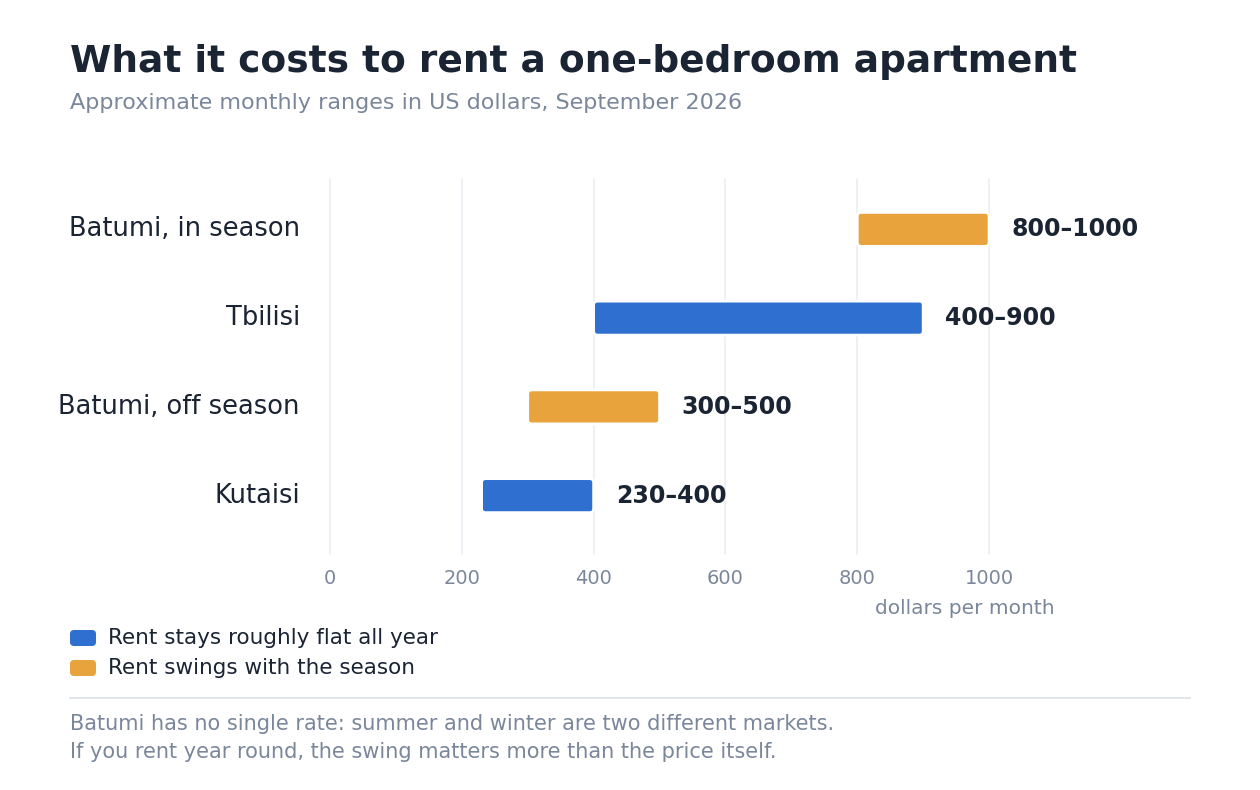
The figures on the chart are approximate and were gathered from listings and market reviews as of September 2026. The exact rate depends on the district, the condition of the flat and the length of the lease, and the market moves. What to read here is not the specific numbers but the shape: two flat bars and one city that runs in two modes.
Money and crypto: how the cities differ
A sizeable share of the people moving to Georgia are paid in crypto: fees from clients abroad, salaries in remote teams, payouts under contracts. For many of them this became one of the arguments for the country. Operations with virtual assets are legal here, the market is regulated by the National Bank, providers hold licences, and crypto does not have to be hidden. It can be exchanged openly and brought into the banking system.
That leads to a conclusion city guides rarely reach. If crypto is a working tool for you rather than a hobby, how easily you can handle it becomes as much a part of urban infrastructure as schools, clinics and transport. And on that measure the three cities differ more than you might expect.
Banks, for what it is worth, work the same way across the country. Bank of Georgia and TBC have branches in all three cities, accounts are opened on identical terms, and questions about incoming funds follow the same rules everywhere. The network of crypto exchangers and crypto ATMs, on the other hand, is spread unevenly, and the difference shows the moment the sum grows beyond everyday size.
Tbilisi
Dozens of exchangers with physical offices and about as many crypto ATMs. A large amount can be closed offline in a single visit: turn up, exchange, take the cash or have it credited to a Georgian account, collect the paperwork for the deal. For anyone exchanging regularly, or cashing out a large sum once, the capital offers the widest choice in the country.
Batumi
A handful of operators run offices here, and crypto ATMs sit in shopping centres and retail spots. Everyday amounts are easy: changing two or three hundred dollars is a walk to the counter on any given day. The complications start once the sum stops being an everyday one.
Rates in a resort city are almost always worse than in the capital, and the reasons are structural. Local desks turn over less, competition is thinner, cash has to be brought in from Tbilisi, and in summer tourist demand lets operators keep their margin high. A large transaction, say a down payment on a flat or settling up for a car, also has to be arranged in advance: nobody can promise the amount you need will be in the till on a particular day, and off season that becomes more noticeable.
For people living in Batumi, a remote exchange usually works out better. You place the order online, the rate is locked in the moment you create it, and the money lands in an account at any Georgian bank. There is nothing to travel to, the paperwork for the transaction arrives electronically, and you get the capital's rate without the resort markup. A trip to a local desk still makes sense for small amounts of cash you need within the hour.
Kutaisi
The infrastructure here is thin: crypto ATMs exist, offline exchange offices effectively do not. That leaves two working options. An ATM covers minor spending and runs around the clock, but you pay for that convenience with an extra fee, and the per transaction limit is low. A trip to Tbilisi costs four hours on the road each way, the ticket, and a full working day, so whatever you gain on the rate tends to disappear into the journey.
That leaves the option that turns out to be both the simplest and the most profitable for Kutaisi: a remote exchange with the funds credited to a Georgian bank account. The rate is the same one a client gets at the Tbilisi office, because it depends on the amount and the currency pair rather than on where you happen to live. Travelling to the capital is worth it only when you need the money in cash and the sum is large.
The general rule holds in all three cities. A crypto ATM is convenient for small amounts and works at any hour, but its limits are lower and its rate is worse than at an exchange office. On a couple of hundred dollars the difference is barely there. On several thousand it is already worth counting.
A word about us here. We have been working in the Georgian market since 2022 and were among the first in the country to receive a VASP licence from the National Bank of Georgia. We now have more than 10,000 active clients, and by transaction volume we are the largest OTC desk in Georgia. Our Google Maps rating is 4.9 across more than 1,000 reviews, and our Trustpilot score is 4.6.
Our office is in Tbilisi at 5 Kote Marjanishvili Street, though coming in person is optional. For anyone living in Batumi, Kutaisi or a smaller town, that means the capital's rate is available without the trip to the capital. For companies we run a separate B2B service: a dedicated account manager, support on large volumes, and a full set of documents for every deal.
Which city suits whom
There is no universal winner in this comparison, so here it is briefly, by situation.
You work with a team or with clients, meet people often, and plan to stay a while. Tbilisi. The capital earns back its price in contacts, services and the fact that almost anything can be sorted out on the spot.
You have a family with a school-age child, and doctors and curricula matter. Tbilisi. Elsewhere the choice narrows so far that you end up shaping your life around whatever is available.
You work remotely, your schedule is your own, and you are willing to leave for the winter. Batumi. Six months by the sea are worth moving base for the other six.
Costs come first, you want quiet, and you mostly fly to Europe. Kutaisi. This is where you will save the most, provided you are ready to look for some services in another city.
You have not decided yet and want to look around. Start in Tbilisi and take trips to the other two. That is two weekends. Moving within the country is quick and cheap, so getting the choice wrong here costs less than it would almost anywhere else.