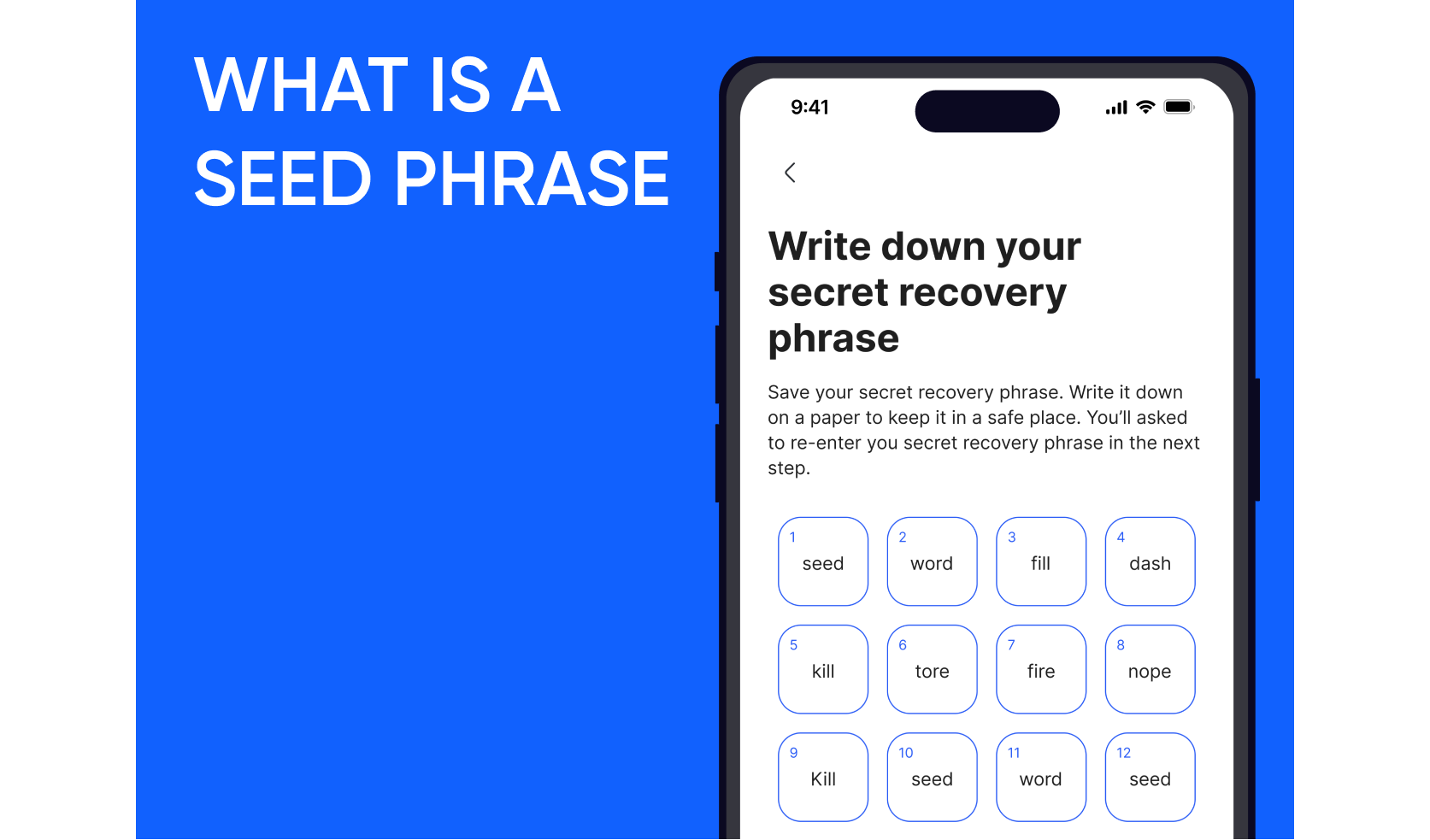
Managing your own crypto comes down to one brief line of 12 or 24 words. That line is what people call a seed phrase. Let it reach the wrong person, and your balance can be drained in a matter of minutes. Misplace it yourself, and the door to your assets shuts permanently, with nobody able to reopen it, the wallet's own creators included.
A few figures make the scale obvious. Ledger's analysts estimate that somewhere between 2.3 and 3.7 million bitcoins sit permanently out of reach as of today. Much of that supply is frozen for one reason: the holders mislaid their passwords and seed phrases. Below we walk through what a seed phrase actually is, the way it operates, how it stands apart from a private key, and the habits that keep it safe so you avoid the errors others have already paid for.
What a Seed Phrase Is in Plain Words
A seed phrase, sometimes labelled a recovery phrase, is an ordered list of words that lets your wallet rebuild every private key it controls through a fixed algorithm. Put simply, it is your money expressed in a shape a human can actually read and copy. You will see it referred to under several labels depending on the app or the guide: mnemonic phrase, recovery phrase, secret phrase. The thing they all describe is identical.
That word, mnemonic, captures the whole point of the format. Asking a person to transcribe and double-check a long run of binary digits is a recipe for errors, while a handful of plain words goes onto paper quickly and with far fewer slips. So the standard repackaged a cryptographic secret as a readable word list.
One point deserves emphasis. Your seed phrase lives nowhere on an exchange, carries no link to your name, number, or inbox, and never rests on any company's servers. It works as a self-contained key. Possession alone decides ownership of the wallet, and the network has no way to tell a thief from the legitimate holder.
What a Seed Phrase Looks Like and How Many Words It Contains
The majority of wallets in use today are built around the BIP39 standard. Within it, the phrase runs to either 12 or 24 words, each drawn from a set dictionary of 2048 entries. Some setups also offer an 18-word option. A longer phrase carries more entropy and, in theory, more resistance to guessing, which is the usual reason people pick 24 words once serious sums are involved.
On screen the phrase reads as a plain run of English words arranged in a fixed sequence. To show the shape without exposing a real one, here is a dummy line that should never be entered anywhere:
abandon ability able about above absent absorb abstract absurd abuse access accident
Sequence is not optional. Shuffle the words and you either land on a completely different wallet or trigger an error. A checksum is baked into the standard, which is why an arbitrary collection of words gets rejected outright: the final word is derived from the ones before it and acts as a validity test.
How a Seed Phrase Works: The Link to Private Keys
Seeing the full pipeline makes the importance of the phrase clear. The word list is run through an algorithm to produce a binary seed. That seed yields a master key, and the master key branches out, following a tree structure, into every private key and address you will use. Wallets built this way are termed hierarchical deterministic, or HD wallets, and the behaviour is laid out in the BIP32 and BIP44 specifications.
That structure also explains how a private key and a seed phrase part ways. A private key unlocks a single address and nothing more. The phrase, by contrast, brings back the whole wallet, every address and every supported chain, on whatever compatible device you reach for. Type the 12 or 24 words into a fresh wallet and the entire balance answers to you again. Knowledge of the phrase therefore equals command of the funds, and there is no second factor by text message or email standing in the way.
Why You Must Never Lose a Seed Phrase or Show It to Anyone
The rule cuts two ways, and neither is forgiving.
Lose it and the access is gone for keeps. A non-custodial wallet offers no password-reset link and keeps no spare copy of your keys anywhere. Once the phrase is gone and the device is out of reach as well, nothing remains to rebuild the wallet from. Recent reporting puts billions of dollars in crypto in exactly this frozen state, traced back to forgotten passwords and seed phrases. Support staff are powerless here in the literal sense: your phrase was never theirs to see or hold.
Hand it over and your balance is stolen. Whoever ends up with those words can sweep the assets out at once, with no way to claw them back. The numbers show how eagerly criminals work this angle. Personal-wallet breaches climbed to around 158,000 cases, and the losses tied to them came to roughly 713 million dollars. Across the year, crypto fraud drained on the order of 11.4 billion dollars, up by close to 22 percent.
The playbook keeps shifting, too. The current wave leans on AI-assisted phishing, deepfake clips, counterfeit sites, and rogue browser add-ons. A common move is a message from "support" pressing you to "sync," "verify," or "check" the wallet, all of which supposedly call for typing in the seed phrase. Treat every such ask as a robbery attempt. No real support channel will ever request your recovery phrase.
Where and How to Store a Seed Phrase Safely
Sound storage follows one rule: keep the phrase off the internet and keep more than one copy. The methods below hold up in practice.
Copy the phrase out by hand and produce at least two versions kept in separate physical spots. Should a fire, a relocation, or some ordinary mishap claim one of them, the other still gets you back in.
When you need durability over years, turn to metal: steel plates or capsules that the words are stamped or locked into. Fire, water, and corrosion barely touch metal, whereas paper gives way to any one of them.
Stash the copies somewhere protected, whether a safe at home, a deposit box at a bank, or a mix of both. As the value at stake grows, so should the care you put into choosing the spot.
Sizeable holdings are a good case for splitting the secret through Shamir Backup, defined by the SLIP39 standard. The phrase breaks into several shares, say on a "3 of 5" basis, and no lone share gives the secret away. The single point of failure disappears: one share lost or grabbed will not cost you the wallet. Trezor's Safe 3 and Safe 5 devices are among the hardware that handles this natively.
There is one more shield available, the passphrase, often called the 25th word under BIP39. It is a secret string of your own choosing tacked onto the phrase. Should your 24 words leak, the funds stay locked without that extra string. The catch cuts both ways: forget the passphrase and the access is just as permanently lost, so treat it with the same seriousness.
What You Must Never Do With a Seed Phrase
Recurring habits account for most of the losses. Here is the list of things to rule out completely.
Skip the camera entirely, no photos and no screenshots. A snapshot drifts into your gallery, your cloud sync, and your phone's backups, any of which can be siphoned off.
Keep the words out of notes apps, chats, mail, and cloud folders. Every one of those is online territory that hacking and leaks can reach.
Never key the phrase into a website or a so-called "seed phrase generator." Tools like that exist to harvest whatever gets typed. Any checking belongs strictly inside your own wallet on your own hardware.
Do not pass the words to anyone posing as support, an admin, or an exchange staffer. And refuse to lean on one lone copy, since losing it leaves nothing in reserve.
What to Do If a Seed Phrase Is Lost or Compromised
Your next step hinges on the circumstances. If the phrase slipped away but you still control the device and the wallet, move fast. Spin up a new wallet with a fresh seed phrase, record it on the spot by the rules above, and shift every asset over to the new address. From then on, regard the old wallet as unsafe.
If you have reason to think the phrase reached someone else, an entry on a shady site for instance, send the funds to a new secure wallet without waiting. There is no "refresh" or "reinforce" for a compromised phrase. It stays, indefinitely, a key that an outsider holds.
And when the phrase is gone for good with no path back into the wallet, the honest answer is blunt: recovery is usually off the table. The crowd of "seed phrase recovery services" pledging help for a cut are, more often than not, scams in their own right. Which is why getting the storage right beats any after-the-fact rescue attempt.
Seed Phrases on Exchanges and in Custodial Services
A clear line separates two kinds of services. With a centralized exchange, the platform itself holds the private keys. You sign in using a username, a password, and two-factor checks, and no seed phrase is handed to you, because ownership of the keys never passes to you. Arrangements like this go by the term custodial.
Seed phrases turn up in the non-custodial camp, in the likes of MetaMask, Trust Wallet, Tonkeeper, and similar apps. There the keys are yours alone, and so is the duty of guarding them. Total command over your assets carries that obligation as its counterweight.
GeCrypto runs as a VASP licensed by the National Bank of Georgia, offering crypto exchange to companies and individual customers alike. Nothing about an exchange with us requires surrendering your seed phrase. After you pull funds out to a non-custodial wallet of your own, how secure they stay comes down to the discipline you bring to handling the recovery phrase.
Frequently Asked Questions
How does a seed phrase differ from a private key?
One private key unlocks a single address, whereas a seed phrase brings back the full wallet, covering every address and network in one go.
How many words are in a seed phrase, and can I choose 12 or 24?
BIP39 allows 12, 18, and 24-word forms. Plenty of wallets let you pick the length at setup, and 24 words give the stronger margin once larger balances are in play.
Can a wallet be restored without a seed phrase?
Not in the non-custodial case. With neither the phrase nor a reachable device, there is simply nothing left to rebuild from.
Can a seed phrase be changed?
The phrase behind an existing wallet is fixed. Getting a new one means creating a new wallet and moving the funds across.
What happens if I enter someone else's seed phrase into my wallet?
The app loads whichever wallet that phrase belongs to. That is precisely how thieves reach other people's money, which is why typing in a phrase that is not yours is out of bounds.
Is it safe to store the phrase in a password manager?
A manager beats jotting it into your phone's notes, yet it remains an online tool. Once the amounts matter, keeping the phrase offline on paper or metal is the safer call.