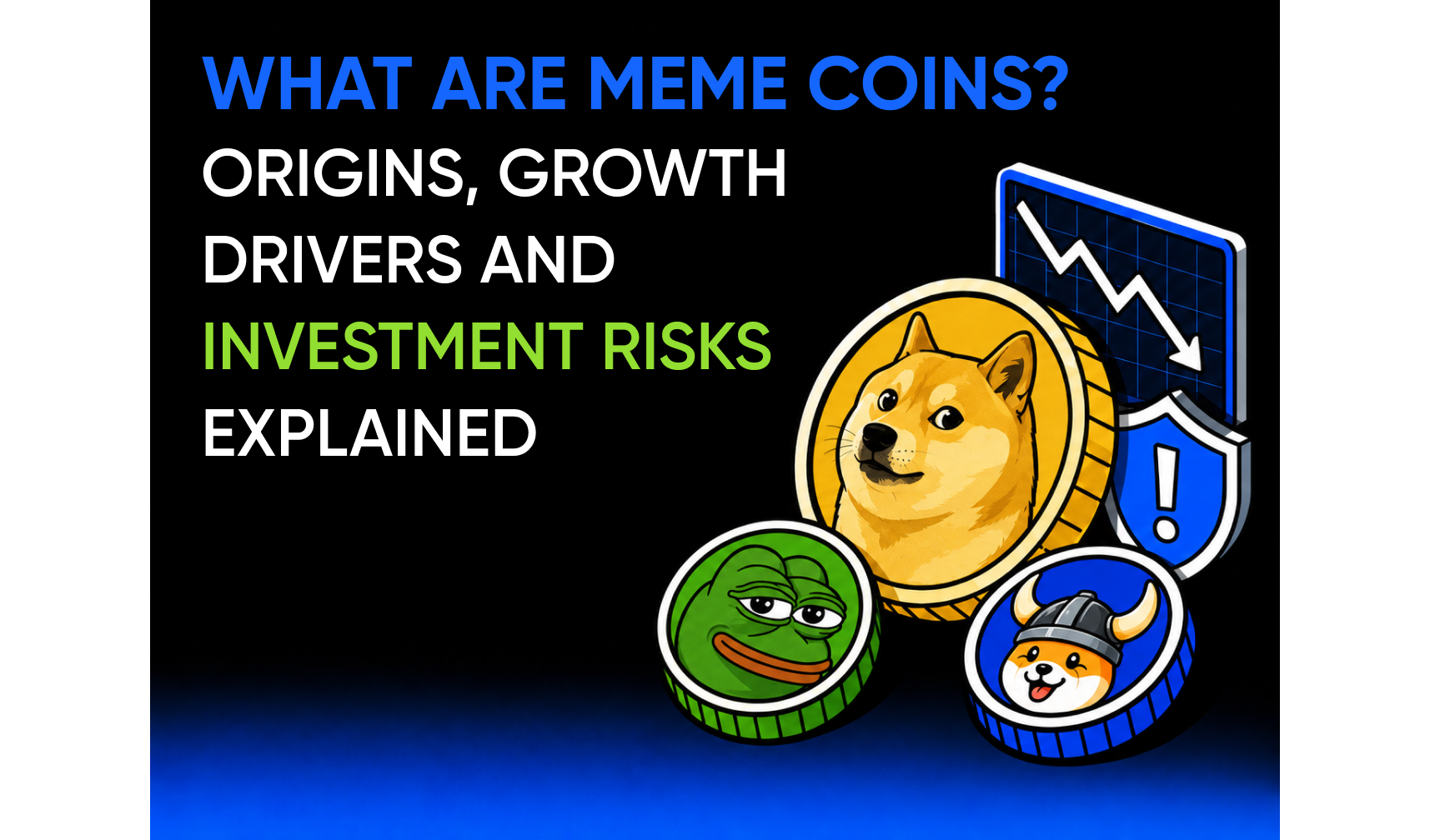
Meme coins are no longer a small comic corner of the crypto market. A few years ago, the topic was mostly associated with Dogecoin and Shiba Inu. By 2024–2026, however, the market had changed dramatically. Meme coins became a separate speculative segment with launchpads, Solana-based trading cycles, political tokens, copycat projects, trading bots, liquidity races, and extremely short market narratives.
In 2021, a meme coin was often understood as a viral token supported by jokes, tweets, and online communities. In the 2024–2025 cycle, the model became much faster and more infrastructure-driven. Platforms like Pump.fun made token creation almost instant, while Solana became one of the main ecosystems for rapid meme coin trading.
So, in 2026, the question "what are meme coins?" can no longer be answered only through Dogecoin. Meme coins are now a high-risk crypto market segment where internet culture, liquidity, speculation, social media, and trading infrastructure interact in real time.
What Are Meme Coins?
Meme coins are cryptocurrencies or tokens inspired by internet memes, viral images, jokes, characters, public figures, political events, or online communities. The term combines "meme," meaning a cultural idea or image that spreads online, and "coin," meaning a crypto asset.
Unlike infrastructure-focused crypto projects, meme coins are usually not built around solving a technical problem. They often do not have their own blockchain, complex product, or tokenomics. Most of them are issued as tokens on existing networks such as Solana, Ethereum, BNB Chain, or Base.
Their value is usually shaped by a different set of forces:
- community attention;
- viral distribution;
- liquidity on exchanges and DEXs;
- speculative demand;
- recognisable branding;
- influencer and trader activity;
- the speed at which a narrative spreads.
At the same time, meme coins are real market assets. They can trade on major exchanges, reach multibillion-dollar valuations, and become major drivers of retail activity. Their risk profile, however, remains much higher than that of more established crypto assets.
How Meme Coins Started: From Dogecoin to Launchpad Culture
The history of meme coins usually begins with Dogecoin. It was launched in 2013 as a humorous response to the early crypto boom and used the well-known Shiba Inu dog meme. What began as a joke quickly built a loyal community and became used for tipping, microtransactions, and online culture.
The second major wave came during the 2020–2021 bull market. Shiba Inu, Floki, and many other dog-themed tokens tried to repeat the success of Dogecoin. This wave was driven by retail FOMO, social media, DeFi growth, and listings on major crypto exchanges.
But to understand the meme coin market in 2026, the most important phase is the third wave, which began in 2024 and continued through 2025. This wave was defined by infrastructure. Meme coins were no longer launched only as isolated viral projects. They became part of a fast-moving launchpad economy.
Pump.fun, in particular, changed the mechanics of meme coin creation. It allowed users to launch tokens without writing complex smart contracts or manually setting up liquidity. This dramatically lowered the barrier to entry and led to a surge in new meme coins. According to CoinGecko, launchpad meme coins grew from 1.5% of the meme coin market in July 2024 to a peak of 20.5% in January 2025, while average daily trading volume for launchpad meme coins rose from $117.6 million in July 2024 to $1.2 billion in November 2025.
What Changed in 2024–2026?
The biggest change is speed. Meme coin cycles have become shorter, more crowded, and more aggressive. A token can launch, attract liquidity, trend on social media, peak, and collapse within days or even hours.
Solana Became a Meme Coin Hub
Solana became one of the main networks for the third wave of meme coins because of its low fees and fast transaction processing. Meme coin trading often involves many small, rapid trades, so transaction cost and speed matter.
BONK, dogwifhat (WIF), and many other Solana-based tokens became symbols of this new cycle. Solana meme coins turned into a distinct market category rather than a simple copy of older Ethereum-based meme tokens.
Pump.fun Changed the Launch Model
Pump.fun became one of the defining platforms of the 2024–2026 meme coin market. Its model made token creation fast and accessible, and it introduced a launch environment where users could buy very early, often before a token had any meaningful community.
This created a market where speed became central. Traders started competing to identify early narratives, follow wallet activity, use bots, track social signals, and exit before liquidity disappeared.
CoinGecko data shows how volatile this environment became for traders. From April 2024 through late 2025, most active Pump.fun traders ended each month at a loss, with the share of profitable wallets bottoming at 30.1% in June 2025. In early 2026, the trend improved: 56.8% of traders were profitable in February, 70% in March, and 73.3% in April, though many profits remained small in dollar terms.
Political Meme Coins Became a Separate Trend
In 2025, political and celebrity-linked meme coins became highly visible. Official Trump (TRUMP), MELANIA, and many copycat tokens showed that meme coins could be built not only around animals or internet jokes, but also around political identity, public personalities, and news cycles.
This direction attracted attention quickly, but it also introduced extra risk. After the launch of Trump-related tokens, The Guardian reported that more than 700 copycat coins appeared using Trump or family-related themes.
The Hype Cycle Became Shorter
By 2026, meme coins no longer looked like a simple "everything goes up" market. Many tokens from the 2024–2025 wave lost most of their value or disappeared from active discussion. The number of launches remained high, but market attention became more selective.
This does not mean the niche is closed. It means the market became harsher. Stronger projects need liquidity, a clear narrative, a committed community, and enough staying power to survive beyond the first speculative rush.
Why Do Meme Coins Rise in Price?
Meme coin rallies are rarely explained by traditional fundamentals. They usually come from a combination of cultural, behavioural, and market factors.
Viral Appeal
A successful meme coin must be easy to understand. The idea has to spread quickly. A dog, a frog, a political figure, a catchphrase, or a community joke can become a market narrative if enough people recognise it.
Retail FOMO
Meme coins are built for fear of missing out. Stories about early buyers making extreme returns create urgency. New participants enter because they do not want to miss the "next one," which can push prices higher for a short period.
Low Nominal Price
Many meme coins trade at fractions of a cent. This creates the illusion that the token is "cheap," even when its market capitalisation is already high. New users often focus on the price per token instead of supply, liquidity, and valuation.
Exchange Listings and Liquidity
When a meme coin is listed on a major exchange, its potential buyer base expands. Liquidity improves, trading becomes easier, and the token may gain credibility. But listings do not guarantee further growth. In many cases, early holders use the new liquidity to take profits.
Trading Infrastructure
In 2024–2026, bots, launchpads, DEX aggregators, Telegram trading tools, and on-chain analytics became central to meme coin trading. This made the segment faster and more competitive. For casual users, it also made the market harder to navigate.
How Meme Coins Differ From Other Crypto Assets
Meme coins differ from infrastructure projects in several important ways.
First, they usually have a weaker technological foundation. Most meme coins do not create a new blockchain, solve scalability issues, or build complex infrastructure. They compete for attention rather than technical superiority.
Second, their life cycle is shorter. A serious infrastructure project may develop over years through product updates, developer adoption, ecosystem growth, and partnerships. A meme coin can move from launch to peak to collapse in a few days.
Third, token distribution matters more than many beginners expect. If a large share of supply is held by insiders, early wallets, the project team, or a small cluster of traders, the risk of sudden selling is much higher. In practice, such a token becomes dependent on a narrow group of holders who can strongly influence price, liquidity, and market sentiment. This is also connected to the broader question of centralization in crypto projects, which we covered in a separate article. For launchpad meme coins, this factor is especially important. Early access can give a major advantage, while later buyers may enter after the most profitable phase has already passed. That is why wallet distribution, early holder concentration, and liquidity structure are often more useful signals than the meme itself.
Fourth, fundamental analysis is limited. With traditional crypto projects, users can study product adoption, revenue, TVL, network activity, developer metrics, and partnerships. With meme coins, the most important signals are often liquidity, narrative strength, community energy, wallet distribution, and social momentum.
The Most Important Meme Coins by Market Wave
The meme coin market is easier to understand through waves. Each wave changed the mechanics of the segment.
First Wave: Dogecoin
The first major meme coin wave was Dogecoin (DOGE). It launched in 2013 as a joke based on the Shiba Inu dog meme, but later became a widely recognised crypto asset with a strong community and deep liquidity.
Dogecoin proved that a crypto asset could gain value through culture, recognisability, and community participation rather than technical innovation alone. It created the template for the entire meme coin category.
Second Wave: Shiba Inu, Floki, and PEPE
The second wave came during the 2020–2021 bull market and continued into the next cycle through stronger cultural tokens. Shiba Inu (SHIB), Floki (FLOKI), and later PEPE became key examples.
Shiba Inu tried to build on the Dogecoin model with stronger ecosystem branding. Floki developed around community and aggressive marketing. PEPE showed that meme coins did not need to be dog-themed to gain major traction. A powerful internet symbol could be enough.
This wave turned meme coins into a recognised speculative category. Viral branding, community pressure, exchange listings, and "early entry" psychology became the main growth drivers.
Third Wave: BONK, WIF, Solana Meme Coins, and Pump.fun
The third wave began in 2024 and became much larger in terms of the number of launches. BONK, dogwifhat (WIF), and many Solana-based meme coins became its most visible symbols.
Solana provided the environment: low fees, fast settlement, and an active retail trading culture. Launchpads provided the mechanism. Pump.fun and similar platforms changed the market from occasional token launches into a constant stream of new meme coins.
CoinGecko's 2025 meme coin report noted that the total meme coin market cap reached a peak of $150.6 billion in December 2024, while daily trading volumes surged sharply compared with 2023.
Political and Celebrity Wave: TRUMP, MELANIA, and Copycats
In 2025, political and celebrity meme coins became a major subtrend. Official Trump (TRUMP) and MELANIA showed that public names, political narratives, and media cycles could quickly turn into tradable tokens.
This wave was highly visible but also risky. Copycat projects appeared almost immediately, many of them trying to look connected to famous people or political brands. This made the segment especially dangerous for inexperienced users.
2026: Less Euphoria, More Selection
By May 2026, the meme coin market had become more selective. Older brands like DOGE and SHIB still had liquidity. Solana meme coins such as BONK and WIF remained important. Launchpad tokens continued to appear, but most had extremely short life spans.
The niche did not disappear. It became more competitive. Projects without liquidity, community, or a strong narrative lose attention quickly. The market now rewards speed and experience more than simple enthusiasm.
Meme Coins in 2026: Is the Niche Still Alive?
The meme coin market is not dead, but it has changed. The easy phase of the 2024–2025 boom has passed. Traders are more selective, liquidity rotates faster, and many new launches fail quickly.
Several trends define the market in 2026:
- fewer projects retain attention for long;
- launch volume remains high;
- profits are concentrated among faster and more experienced traders;
- large meme coins still attract liquidity;
- launchpad ecosystems remain active;
- political and celebrity tokens add legal and reputational risks;
- retail users face stronger competition from bots and professional traders.
The partial recovery in Pump.fun trader profitability in early 2026 suggests that activity has not disappeared. But it also confirms that this is no longer a simple retail market where any viral token can survive.
Meme Coins and Regulation
Regulators are paying more attention to meme coins, especially when public figures, aggressive marketing, copycat tokens, and large retail losses are involved. The main concern is not only volatility. It is the combination of unclear teams, hidden token concentration, manipulative promotion, fake branding, and sudden liquidity exits.
Key regulatory concerns include:
- celebrity-linked or political tokens;
- copycat projects;
- undisclosed insider allocations;
- pump-and-dump behaviour;
- aggressive social media promotion;
- fake or hacked accounts used for token marketing;
- weak disclosure around token supply and control.
In 2025, several media reports highlighted scams and abuses connected to meme coin launches. WIRED, for example, reported a case in which a journalist's X account was hacked and used to promote a fake WIRED-branded meme coin through Pump.fun.
This shows that meme coin risk is not limited to price volatility. It also includes technical, legal, reputational, and fraud-related risks.
Should You Invest in Meme Coins?
Meme coins can produce large returns, but they are closer to speculative venture bets than traditional investments. For most users, they are not suitable for long-term capital preservation.
Before buying a meme coin, it is worth checking:
- whether real liquidity exists;
- who holds the largest share of supply;
- whether the token is a copycat;
- whether the price already moved sharply;
- whether the project depends only on influencer promotion;
- whether you can exit without major slippage;
- whether the narrative is still alive or already exhausted.
If meme coins are used at all, they should represent only a small speculative part of a portfolio. The possible loss should be financially acceptable. Buying after a sharp rally, under social pressure, or because an influencer promotes the token is especially risky.