The rate is agreed, the order is almost complete, and one question is left: how do you want the money. Cash at the office, or a transfer to your account. Most people answer out of habit, though the decision deserves a moment. It shapes how soon you can use the money and what paperwork you walk away with.
How it works in practice
Both deals run the same way. You submit an order, get a quote, pass verification and send your crypto to the exchanger's address. Only the last step differs.
With a cash payout you collect the money at the office counter in dollars. You leave with the contract and the receipt for the deal.
With a transfer the amount goes to your account. Money usually reaches a Georgian bank within an hour, and it is available on a linked card as soon as it lands. International transfers take longer, up to three business days, and the exact timing depends on the route and the receiving bank.
So where is the difference
How much you can get at once. A cash desk needs a physical stock of currency, so large cash payouts are booked in advance, usually a day ahead. A transfer has no such limit.
Paperwork. After a transfer you have a bank statement, and it is accepted everywhere: when you buy an apartment, open an account abroad or apply for residency. After a cash payout you have the exchanger's contract and receipt. Those documents are no worse, but you keep them yourself, and finding a piece of paper a year later is harder than downloading a statement in your banking app.
Storage. Cash has to travel from the office and sit somewhere afterwards. For a couple of thousand dollars that is fine. For several tens of thousands it becomes a real question, especially without a safe at home.
When cash is the better choice
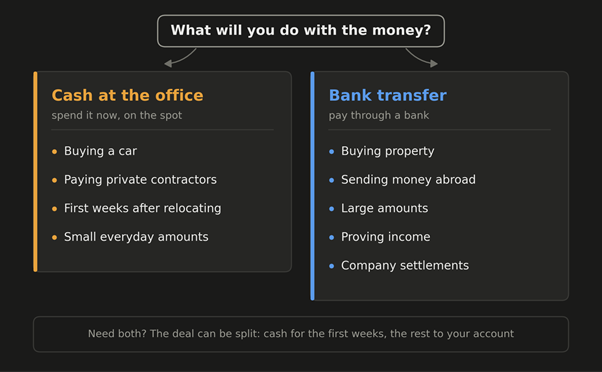
Cash wins when the money goes to someone who may not have a suitable account, or when you plan to spend it within days.
Buying a car. A large flow of resale cars passes through Georgia, and paying in cash is still normal at dealerships and markets. Sellers do not always want to wait for a transfer, and some prefer to keep the payment off their account. We covered how to structure that safely in the guide on buying a car with USDT.
Paying private contractors. Renovation work, furniture delivery, rent paid straight to the owner. Asking for bank details from people who work in cash rarely goes anywhere.
Your first weeks after relocating. A Georgian bank account does not open on the day you land, and rent is due right away.
Small everyday amounts. If you need two or three hundred dollars, waiting for a transfer and then visiting an ATM makes little sense.
There is a flip side. Cash leaves no trace in the banking system, so if a bank asks about the origin of your money a year from now, you will be looking for an exchanger's contract instead of opening a statement.
When a bank transfer works better
Buying property. The settlement runs through a bank and a notary, and you cannot pay the seller in crypto directly. Cash brought to a bank counter starts a conversation about the source of funds at the worst possible moment, so it is simpler to take the amount to your account. More on that in the guide to buying real estate with crypto.
Sending money abroad. A payment to a European or Emirati bank can only leave from an account. A receiving bank treats an incoming payment from a licensed provider more calmly than a cash deposit at a branch.
Large amounts. At tens or hundreds of thousands of dollars a transfer is both easier and safer: nothing has to be carried anywhere, and the record of the operation keeps itself.
Paying for services and proving income. Tuition, medical treatment, a mortgage, a residence permit. All of them ask for a statement rather than a receipt.
Companies have almost no choice here. Accepting a large cash settlement runs into cash discipline, source documents and reporting, so a business converts crypto to fiat through its account.
How the deal works at a licensed exchanger
The sequence does not depend on the payout you pick. You submit an order and get a quote, the rate is locked for the duration of the deal, then come verification and an AML check of the coins, and after your transfer you receive the money.
You can also split the payout: take part in cash for immediate spending and send the rest to your account. People relocating do this more often than anything else.
GeCrypto operates in Tbilisi on Kote Marjanishvili Street and is registered with the National Bank of Georgia as a virtual asset service provider, number 0018-9404. Cash is paid out at the office, transfers go to accounts at Bank of Georgia, TBC and other Georgian banks in lari, dollars or euros, and money leaves the country through SWIFT, SEPA and ACH. Deals start at 100 dollars, and larger volumes are arranged in advance.
FAQ
Can you sell bitcoin for cash in Georgia?
Yes. Virtual asset operations are legal in the country, and a deal through an exchanger registered with the National Bank of Georgia is fully compliant.
Where can I sell my bitcoin for cash?
The realistic options are a crypto ATM, a private buyer or a licensed exchanger with a real office. Only the last one leaves you with a contract for the deal, and only there is the amount not capped by a machine. Our office sits in central Tbilisi on Kote Marjanishvili Street, and it handles bitcoin, USDT, USDC, Ethereum and Solana alike.
Is there a difference between cashing out USDT and BTC?
The procedure is identical, only network confirmation times differ. USDT on TRON arrives in about a minute, while bitcoin waits for a block, which takes roughly ten. Your rate is locked for that time, so market moves do not change your amount.
Is the rate different for cash and for a transfer?
No, the quote is the same. Pick whichever suits you.
What is the cheapest way to convert crypto to cash?
Compare the final amount you receive rather than the advertised commission, because a "0% fee" usually means the margin sits inside the rate. It is also worth asking whether the quote is locked for the deal or recalculated when your transfer arrives.
Can I take part of the amount in cash and the rest to a Georgian bank account?
Yes, within a single deal. People relocating usually do exactly that: cash for the first weeks, the rest to an account.
Can I sell crypto for cash without verification?
No. A licensed exchanger identifies the client at any amount. Services promising an exchange without documents operate outside the legal framework.
Do I need a Georgian bank account to sell crypto?
Not for a cash payout, where a passport and completed verification are enough. A transfer needs bank details, and they do not have to be Georgian. If a bank later asks about the incoming payment, show the contract and the receipt, and we covered what banks check in a separate article.