A large exchange almost always comes out of a specific task: buying an apartment in Tbilisi or a car, paying a contractor, moving capital after a relocation, selling a stake in a business. The amounts run into tens and hundreds of thousands of dollars, and everyone asks the same question: can you exchange that much in one go.
Georgian law sets no maximum on the amount you exchange, and the country has no currency controls. The ceiling appears one level down, at the specific service your money goes through.
What the law says: verification thresholds instead of caps
Georgian legislation does contain numbers, but each one marks the amount at which a company has to identify the client, not the amount above which a transaction becomes illegal.
Article 11 of the Law on Facilitating the Prevention of Money Laundering and the Financing of Terrorism sets several thresholds:
virtual asset transactions: client identification from 3,000 GEL, roughly the equivalent of 1,000 dollars or 1,000 euros;
cash carried across the border: a declaration is required above 30,000 GEL, roughly 11,000 dollars, and failing to file one brings a fine of 30,000 to 50,000 GEL or confiscation of the whole amount.
Formally an exchanger may skip documents below 3,000 GEL, yet licensed companies verify everyone: GeCrypto asks for documents on every deal regardless of the amount. The threshold itself is telling, for other reporting entities it sits at 15,000 GEL and for crypto services it is five times lower. What grows with the amount is the depth of the source-of-funds check.
Where the real limits appear
The intermediary sets the limit, and every channel has its own.
Exchanges
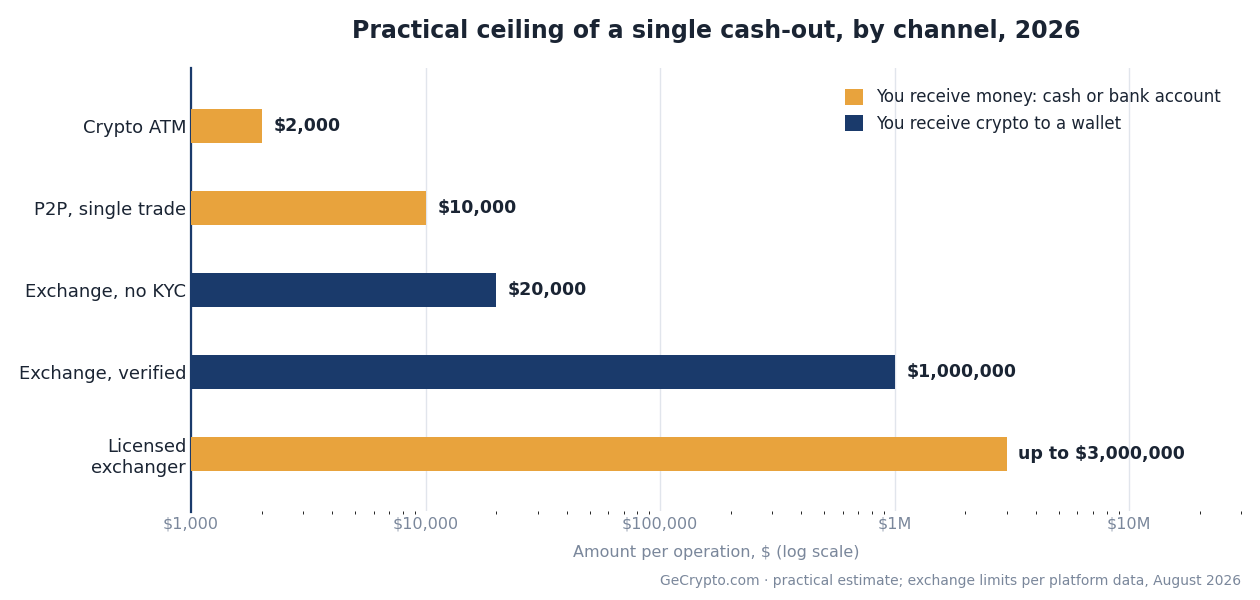
Major platforms tie limits to the verification level. At Bybit, as of August 2026, an account without KYC withdraws up to 20,000 USDT a day and up to 100,000 USDT a month. Basic verification raises the bar to 1 million USDT a day, advanced verification to 2 million, a corporate account to 4 million. Binance and OKX follow similar logic.
The bottleneck hides somewhere else: all of those numbers apply to crypto leaving for a wallet. Pulling lari or dollars out of an exchange straight into a Georgian bank account is close to impossible, because fiat rails for Georgia either do not exist or run through intermediaries with limits of their own.
P2P
P2P has no formal ceiling, yet the counterparties create a real one. An order for 200,000 dollars has to be split into dozens of trades with different people, each with its own rate and its own risk. The process stretches over days, and a run of identical card top-ups often ends in a frozen account.
Crypto ATMs and small exchangers
Here the limit is physical, everything comes down to the cash in the drawer. An ATM hands over a few thousand dollars, a small office a couple of tens of thousands. At 200,000 or 300,000 dollars such a service asks for several days to prepare or turns the deal down, and the rate on a large ticket usually loses as well.
Banks
Georgian banks set no limit on incoming funds, but they do ask where the money came from. Anything arriving from crypto platforms and P2P counterparties draws a check: the payment can be held and the account frozen until you explain it. The picture changes when the sender is a licensed company with documents for the deal, because the bank finally sees a counterparty it can identify.
Practical ceiling of a single operation, by withdrawal channel
What changes above 100,000 dollars
A large order goes through the same steps as a small one, only each step becomes more visible. The operator runs AML scoring on the coins and asks for documents on the source of funds: a sale contract for a business stake or a property, an exchange statement, a tax return. Transfers between services fall under the travel rule, so sender and recipient details travel together with the money.
Splitting the amount deserves a separate mention. Breaking a million into 5,000 dollar transfers looks convenient and works against the client. The law operates with the concept of linked transactions, so a chain of identical operations lands in reporting as suspicious activity. One transparent deal with a full set of documents goes through more calmly than twenty small ones.
How a large cash-out works at a licensed exchanger
A large order at GeCrypto follows one route. The client states the amount, the asset and the currency they want to receive, and gets a preliminary quote. The service then reserves the volume and locks the rate, the client passes verification, companies prepare a corporate document pack. Once the crypto arrives and clears the AML check, the money goes out to the recipient.
You can take it in cash at the office in central Tbilisi or receive a transfer to a Georgian bank account in lari, dollars or euros. GeCrypto holds a licence from the National Bank of Georgia (registry number 0018-9404) and handles deals of up to several million dollars. A personal manager runs large orders, and the client keeps the paperwork for the bank or the tax office afterwards.
In practice the question about limits comes down to the choice of channel. The law puts no cap on the amount, an exchange runs into the fiat rail, P2P into the number of counterparties, a small exchanger into its cash drawer. If a deal worth hundreds of thousands is coming up, it pays to start the conversation with a licensed service early: the time goes into documents and reserving the volume, not into finding someone willing to take it on.