India, the United States, Pakistan, Vietnam, and Brazil hold the top five places in the Chainalysis crypto adoption index. India and Pakistan both spent years on "crypto is banned" lists, and Pakistan lifted its banking restrictions only a few months ago. Ban lists go stale faster than anyone updates them: many still name countries that scrapped theirs two years ago.
Here is where restrictions actually apply today, how one ban differs from another, and what happens to people who break them.
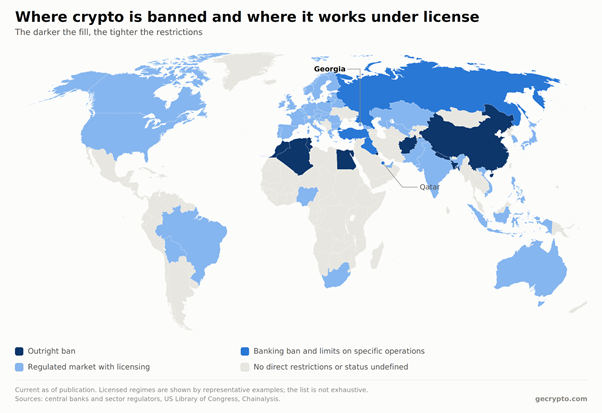
What counts as a ban: three levels of restriction
One word covers three different legal regimes, and the difference matters a great deal to anyone holding coins.
An outright ban.
Buying, selling, mining, and accepting payment are all illegal, and sometimes so is simply holding coins. Algeria went furthest and banned possession explicitly. Most governments stop at restricting transactions and leave your holdings alone.
A banking ban.
Bitcoin in a wallet breaks no law, but banks and payment companies may not process crypto transactions, and exchanges cannot get licensed. You can hold the coins; there is nowhere to turn them into local money. Iraq and Qatar work this way.
A ban on specific activities.
Buying and selling are allowed, and the restriction is narrow: payments in stores, say, or advertising, or one particular class of asset. In Turkey the ban covers payments alone.
Two caveats matter here. First, the absence of a crypto law is not a ban. In most cases the status is simply undefined, and far more countries fall into that group than under any direct restriction. Second, a ban can be license-shaped on paper and absolute in practice, when the law permits business under a license and no license is ever granted.
Where crypto is banned: the full list
| Country | Type of ban | Legal basis | Penalty and enforcement |
|---|---|---|---|
| China | outright | notice by 10 agencies, September 2021; extended by an 8-agency notice on February 6, 2026 | administrative and criminal |
| Algeria | outright | Law No. 25-10, art. 6 bis | 2 months to 1 year, plus a fine of 200,000 to 1 million dinars |
| Afghanistan | outright | government directive, 2022 | exchanges closed, funds seized, arrests |
| Bangladesh | outright | central bank orders under currency, anti-money-laundering, and counter-terrorism law | 4 to 12 years under the AML statute |
| Egypt | license-based, outright in practice | Central Bank and Banking Sector Law No. 194, art. 206 | prison or a fine of 1 million to 10 million pounds |
| Kuwait | outright | joint decision of 4 regulators, 2023 | all crypto activity banned, no licenses issued |
| Morocco | outright | order by the foreign exchange regulator and Bank Al-Maghrib, 2017 | fines |
| Nepal | outright | Nepal Rastra Bank notice | fine up to 3 times the transaction amount, prison |
| Tunisia | outright in practice | Foreign Exchange Code | up to 3 years, plus fines |
| Iraq | banking | Central Bank of Iraq directive, 2017 | AML penalties apply |
| Qatar | banking, with carve-outs | central bank circular No. 6/2018; QFC digital assets framework | crypto classed as excluded tokens |
| Turkey | payments only | central bank regulation, 2021 | administrative |
| Russia | payments and advertising; regional mining limits | Law on Digital Currencies and Digital Rights | administrative |
Current as of publication.
Countries with an outright ban
China
The ban rests on two documents. In 2021 ten agencies declared all business involving virtual currencies illegal financial activity. Four and a half years later, eight agencies led by the People's Bank of China issued a new notice and widened the ban.
The new notice reaches beyond trading in bitcoin and ether. Yuan-pegged stablecoins may not be issued without government approval, whether onshore or through the offshore arms of Chinese companies, and the notice restricted tokenization of real-world assets at the same time. Hong Kong is outside its scope and runs its own licensing regime.
Mining is illegal too, yet it never stopped. Hashrate Index puts China at roughly 12% of the bitcoin network's computing power, which keeps the country among the three largest mining hubs in defiance of its own law.
Algeria
Algeria was the last country to tighten its rules. The old provision in the 2018 finance law was written in broad terms and was barely enforced. In the summer of 2025 the Monetary and Banking Law No. 25-10 took effect and the language hardened sharply: issuing, buying, selling, holding, and advertising digital currencies are all prohibited, with separate offenses for running a crypto platform, using a wallet, and mining.
The penalties are no longer abstract either. Two months to a year in prison, plus a fine of 200,000 to one million dinars.
Morocco
Morocco is moving in the opposite direction. The ban has stood since 2017, yet the authorities are now preparing to lift it. Draft law 42.25 appeared in the fall of 2025, introducing licenses for crypto service providers and splitting supervision between the capital markets authority and the central bank. In the summer of 2026 the regulator confirmed the text was still being refined.
The reason shows up in the numbers. Industry estimates put the number of crypto owners at around six million, roughly one Moroccan in six. There is no official count, but even a rough order of magnitude explains why the government chose regulation over a harder crackdown.
Egypt
The Central Bank and Banking Sector Law prohibits issuing, trading or promoting cryptocurrency and running a trading platform without the regulator's authorization. On paper that is a licensing regime. In practice nobody has ever received the authorization, so the result matches an outright ban.
The central bank has spelled out the penalty: imprisonment or a fine of one to ten million Egyptian pounds. The word to note is "or": one penalty replaces the other rather than being added to it.
Nepal
Enforcement here is strict. The central bank runs cases jointly with the police cyber bureau, and fines reach three times the transaction amount. The law sets no single ceiling on prison terms; the sentence scales with the amount involved.
A reversal is under serious discussion all the same. The ruling party has promised a national crypto policy within the year, and the central bank's own research paper leaves room for a regulated model.
Tunisia
Tunisia has no dedicated crypto statute. The ban rests on the Foreign Exchange Code, which requires central bank authorization for transactions in foreign exchange assets. The current edition of the code names crypto assets explicitly and cuts the maximum prison term from five years to three. A bill now before parliament would allow people to hold crypto and exchange it with the regulator's permission.
Afghanistan, Bangladesh, and Kuwait
Afghanistan.
The ban arrived in 2022 on religious grounds. Sixteen exchange offices were shut in Herat and dealers were detained. There is no published statute; the authorities act by directive.
Bangladesh.
Crypto was banned by central bank orders resting on currency, anti-money-laundering, and counter-terrorism law. No crypto-specific offense exists in the criminal code, so cases run under the AML statute, where the sentencing range is four to twelve years.
Kuwait.
Four regulators led by the central bank closed everything in a single decision: payments, investment, mining, and any licensing of crypto companies.
What falls outside the list
Burundi, Libya, and North Macedonia also turn up on ban lists, though the information is rarely updated and their status is worth checking separately.
One more distinction: mining is sometimes banned in its own right. China, Algeria, and Kuwait shut it down along with everything else, while Russia restricts only mining, and only in certain regions.
Banking bans and partial restrictions
Iraq.
The central bank barred banks and financial companies from any dealings in virtual assets. In the spring of 2026 the interior ministry of Iraqi Kurdistan went further and barred ordinary citizens and businesses from dealing in digital currencies and the USDT stablecoin.
Qatar.
A central bank circular bars banks from working with cryptocurrency. The Qatar Financial Centre, meanwhile, runs a digital assets framework that permits tokenization. Cryptocurrencies and stablecoins were left out of it and classed as excluded tokens.
Turkey.
Paying for goods and services in crypto has been prohibited since 2021, and the ban extends to intermediaries. Buying, holding, and trading are allowed, and exchanges are licensed by the capital markets regulator.
Russia.
Domestic payments in crypto and advertising of such payments are prohibited. Ownership and transactions through licensed intermediaries are allowed, and a new framework, the Law on Digital Currencies and Digital Rights, takes effect on September 1, 2026.
Who lifted a ban in the past two years
Bolivia.
The ban lasted a decade and was withdrawn by central bank resolution No. 082/2024. Transaction volumes multiplied within the first few months.
Pakistan.
The banking ban held for seven years. In the spring of 2026 the central bank allowed banks to serve licensed crypto providers; a virtual assets act was passed at the same time and a dedicated regulator, PVARA, was created. Around forty million people use crypto in Pakistan, one resident in six, and by retail transaction volume the country now ranks third in the world.
Vietnam.
The Law on the Digital Technology Industry pulled crypto assets out of legal limbo, and a pilot regulated market followed. The country ranks fourth in the adoption index.
The motive is identical in all three cases. A ban does not remove demand for crypto; it only pushes trades out of sight, into cash and messaging apps, while the treasury loses the tax revenue.
What happens if you break a ban
Penalties vary widely, from an administrative fine in Turkey to a real prison term in Egypt and Algeria. But the bigger risk lies elsewhere. Many countries have no crypto-specific offense in their criminal codes at all, so cases run under anti-money-laundering law, as in Bangladesh and Iraq. The harsh figures usually quoted as "the penalty for crypto" therefore belong to large laundering cases, not to swapping a couple of hundred dollars for USDT.
Common misconceptions
India.
The country stays on ban lists out of habit. The Reserve Bank did cut banks off from crypto in 2018, but the Supreme Court struck that down two years later. Trades are legal today, profits are taxed at 30% plus a surcharge, and another 1% is withheld on each transaction. India leads the world in crypto adoption.
The European Union and the United States.
Crypto is not banned in any EU country, and a single regulation licenses service providers across the bloc. In the US it is legal at the federal level, and regulators are arguing over who should oversee it rather than whether to allow it.
Kazakhstan, Belarus, Uzbekistan.
None of the three bans crypto, though each regulates it differently. Kazakhstan allows trades through licensed venues at the Astana International Financial Centre. Belarus legalized crypto transactions by Decree No. 8 and channels trading through companies registered in the High Technologies Park. In Uzbekistan the National Agency for Prospective Projects licenses exchanges and exchange offices. All three share one rule: crypto is not legal tender and cannot be used to pay in a store.
Where crypto works legally
Most countries chose licensing over prohibition. The regimes in the EU, the US, the UAE, Singapore, and Japan are built on different lines, yet they share a principle: the market operates in the open, under supervision, with checks on customers and on the origin of funds.
Georgia belongs to the same group. The National Bank has supervised virtual asset service providers since 2023, and requirements for stablecoin issuers were added recently. Per capita, the country ranks in the world's top three for crypto adoption. We covered how the Georgian market works in a separate article.
GeCrypto operates inside that regime. The company is entered in the National Bank of Georgia register as a virtual asset service provider, number 0018-9404. For a client from a restricted country that means a trade in a jurisdiction where it is lawful, with funds checked and the paperwork in hand afterward. Payouts come as cash at the Tbilisi office, a transfer to a Georgian bank account, or an international transfer via SWIFT, SEPA, or ACH.