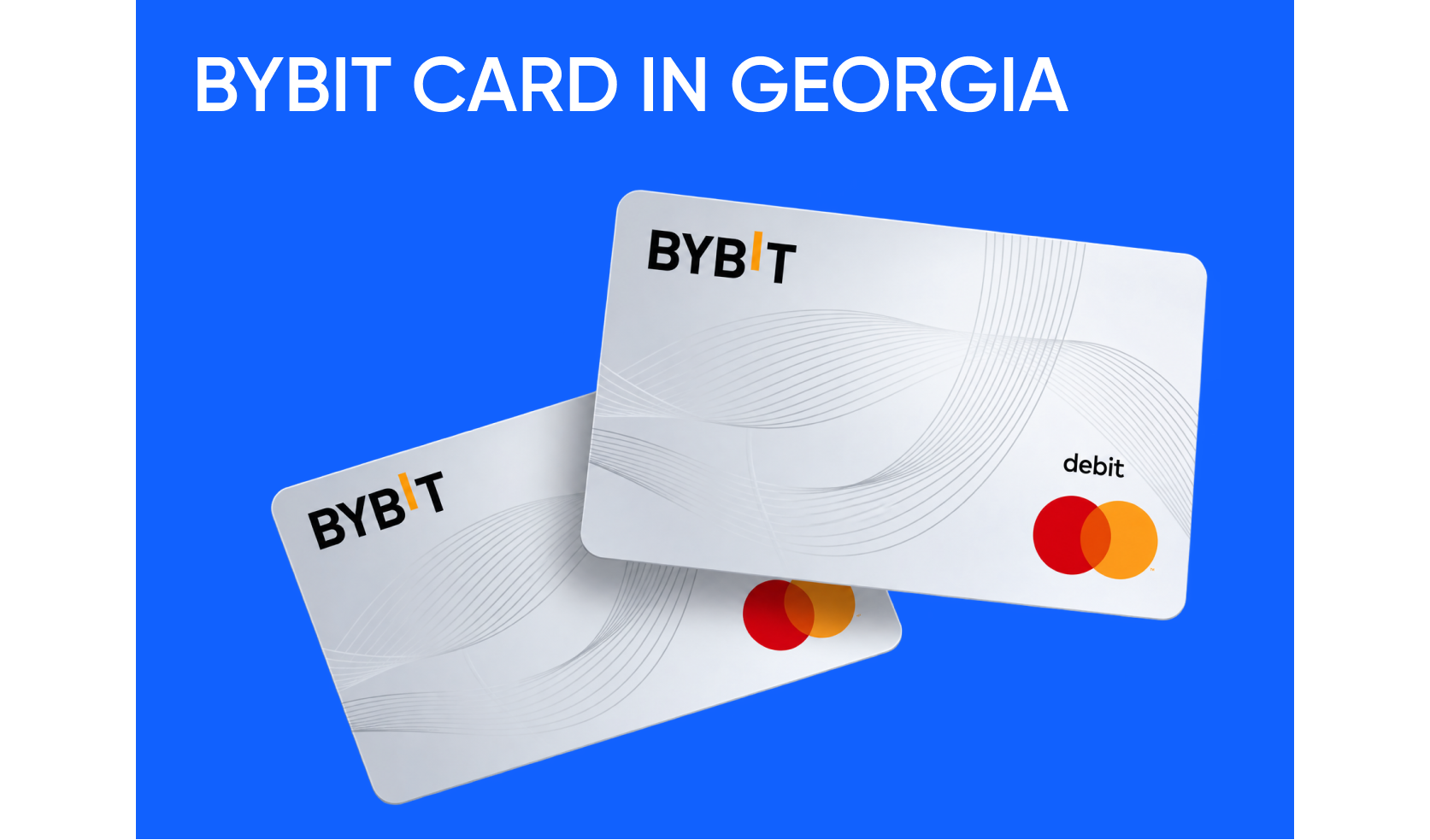
Bybit launched a payment card for Georgia in early 2026. The Bybit Card lets you pay for purchases out of the crypto sitting in your exchange account. If you earn in USDT or keep part of your money in digital assets, that is a convenient way to spend it without filing a separate exchange request before every purchase. Automatic conversion has a price of its own, though, and cashback only offsets it within the limits the loyalty programme sets.
The defining feature of the Georgian card is its settlement currency: US dollars. When you pay in lari from a USDT balance, the transaction involves both an ordinary currency exchange and a sale of a crypto asset. That makes the final amount debited, net of rewards, the only number worth judging the card by. Below we work out how to calculate it, and when converting crypto in advance for a specific purpose beats paying by card.
How the Bybit Card arrived in Georgia
The card launched on 29 January 2026. Structurally it rests on three participants:
- Bybit as the issuer, holding the payment service provider licence it obtained in Georgia in the fourth quarter of 2025
- Mastercard as the payment network
- Pave Bank as the banking partner
In March the product was formally presented in Tbilisi with the Ministry of Economy and the National Bank in attendance, which is telling in itself for a crypto product in this region.
Applying for the card
Applications go through the app or the web version, under Finance → Card. You need Individual Identity Verification Lv. 1 or business verification, a confirmed residential address, a linked phone number and two-factor authentication enabled through Google Authenticator.
Bybit gives specific notice that verification requirements for the card are stricter than for the account itself, and that you may be asked to redo a check you have already passed. Review usually takes a few minutes, though in some cases it stretches to seven business days.
A physical card can only be ordered once the virtual one has been issued. The delivery address has to match the residential address confirmed during verification, and Bybit reserves the right to reject the application if the two differ. Delivery takes up to 30 days. The virtual card is free, the physical one costs 29.99 USDT, and there is no maintenance fee. The card is valid for three years.
What happens when you pay
The Georgian Bybit Card is a prepaid Mastercard with Apple Pay and Google Pay support. It has no wallet of its own: funds are debited from the Funding Account and from Flexible Easy Earn. From the buyer's side the operation looks like any other tap of a phone against a terminal. The merchant receives payment in fiat and never has to accept USDT or open a crypto wallet. The sale of the digital asset happens on the side of the service handling settlement.
The card removes steps between a crypto balance and a purchase. What it does not do is turn USDT into dollars in a bank account, and it does not make the conversion free. For spending in lari, the full chain of conversions has to be accounted for.
Four layers that make up the cost of using the card
The cost of a card transaction never appears as a single line, either in the app or on the receipt. It is assembled from four independent fees, three of which are applied in sequence to an already inflated amount.
The Mastercard markup
When you pay in lari with a dollar-denominated card, the payment network converts the amount at its own rate on the day the transaction is processed. The network's markup on the GEL/USD pair usually amounts to a fraction of a percent.
The foreign exchange fee
This is where the card's defining quirk sits, and it is worth understanding before you apply. Bybit's rule reads as follows: the FX fee applies to transactions in a currency other than the currency the card is denominated in. The Georgian card is denominated in US dollars. Every venue in Tbilisi bills in lari.
The result is that a purchase in the national currency, inside the country where the card was issued, is priced as a foreign currency transaction. Two percent is charged on a grocery run, not only on a trip abroad. The reason is structural: crypto assets are denominated in dollars, settlement between Bybit and its banking partner runs in dollars, and a dollar-denominated card removes currency risk from the issuer's side of the chain. That risk shifts to the cardholder, and the price of the shift is precisely those two percent plus the network spread. For a card issued into a domestic market with its own currency the arrangement looks like a compromise, but it is what allowed the product to launch quickly.
Crypto asset conversion
Charged on every transaction paid with non-crypto-fiat funds from the Funding Account, on top of the Bybit One-Click Sell rate, which already carries the platform's own spread. The minimum conversion amount is 1 USD.
Cash withdrawals
Two percent on anything above the first 100 USD withdrawn in a calendar month. It does not replace the three fees above, it stacks on them, because dispensing lari from an ATM remains a foreign currency transaction for a dollar card, preceded by a conversion out of crypto. Add the ATM operator's own fee where there is one, plus the offer to convert at the ATM's rate, which is always worth declining in favour of being charged in the card's currency.
Take a purchase of 2,613 GEL, which comes to roughly 1,000 USD. Payment is drawn from a USDT balance. We assume a Mastercard markup of 0.3% and a One-Click Sell spread of 0.2%.
| Stage | Amount |
|---|---|
| GEL converted to USD at the Mastercard rate | 1,003.00 USD |
| Foreign exchange fee, 2% | 20.06 USD |
| USDT conversion, 0.9% plus spread | 11.28 USDT |
| Debited from the Funding Account | 1,034.3 USDT |
Cashback and subscription rebates: where the card is strong
The loyalty programme is built around tiers, and your tier is set either by the VIP level of the account or by card turnover over a calendar month.
| Tier | Rate | Monthly cashback cap | Spending threshold for non-VIP |
|---|---|---|---|
| Tier 1 | 2% | ≈ 5 USD | 0 |
| Tier 2 | 2% | ≈ 50 USD | 500 USD |
| Tier 3 | 4% | ≈ 150 USD | 3,500 USD |
| Tier 4 | 6% | ≈ 250 USD | 9,500 USD |
| Tier 5 | 8% | ≈ 400 USD | 12,500 USD |
| Tier 6 | 10% | ≈ 600 USD | 25,000 USD |
There is a separate mechanic that accounts for a good share of the applications: holders at Tier 2 and above receive a full rebate in points on subscriptions to ChatGPT Plus, Claude Pro, Netflix, Spotify, TradingView, Financial Times, Shahid and iQIYI. The rebate only applies when payment goes through the service's official website. Purchases made via app stores, payment platforms and aggregators fall outside the programme.
Work out what that delivers in practice. A standard subscription stack for someone working with text and data lands somewhere around 40 to 60 USD a month. The Tier 2 cap is 25,000 points, which converts to roughly 50 USD of rebate. The overlap is no accident: the product was designed for exactly this job, and at this job it performs, effectively zeroing out the subscription bill.
The constraint deserves equal clarity. Holding Tier 2 without VIP status means putting at least 500 USD a month through the card. A Tier 1 user who took the card purely for subscriptions gets a cap of about 5 USD and no entitlement to the full rebate at all.
Why payments get declined
Complaints about declined crypto card payments come up regularly, and the mechanics explain far more than the emotion in the reviews does. Bybit publishes a table of decline reasons in its help centre, and it accounts for most situations.
The merchant declines it. Bybit states plainly that some sellers reject transactions because the card is prepaid or virtual, or because of the country of issue, the country of the IP address or the country of the billing address. Where the refusal happened on the merchant's side and no record appears in transaction history, Bybit cannot establish the reason, because the event occurred outside its visibility. This is where most of the "Netflix won't take the card" stories belong. Billing systems at a number of services require a debit or postpaid credit card and screen prepaid cards out at the rules level.
Holds and deposits. A hotel blocks an amount on the card at check-in, and car rental companies do the same. A prepaid card fits that scenario poorly, and a refusal at the front desk is a realistic outcome even after a successful online booking.
3DS confirmation. On the Georgian card, 3DS transactions are confirmed with biometrics, and you get 120 seconds to do it. If biometrics are not enabled, the system offers to activate them across four attempts of 60 seconds each. On the fifth attempt confirmation switches to an emailed code, followed by a security question about a recent payment. A wrong answer cancels the transaction outright.
Unattended pumps and magnetic stripe. Payments at automated fuel dispensers and magnetic stripe transactions return a Generic Decline. On a drive through the Georgian regions that comes up more often than you would expect.
Funds held for up to 30 days. Once authorised, the amount is frozen in the Funding Account and only debited when the merchant completes the transaction. The wait can run to 30 days, and the money stays out of reach throughout.
Negative balance. If the rate at settlement turns out worse than at authorisation, or the merchant captures more than was authorised, the balance goes negative. The consequences reach past the card itself: it is suspended, and withdrawals across the entire Bybit account are restricted until the shortfall is cleared.
Account status. The most serious item on the list. When an account is suspended, card transactions stop going through. The card has no balance of its own and inherits the state of the account completely. Bybit's Trustpilot rating sits at around 3.2 out of 5, where account freezes during compliance reviews form a consistent pattern: users describe restrictions lasting weeks and months, templated support replies and no stated timeline. There are cases where the review was triggered by a transfer of a few dozen dollars while the entire balance, card included, fell under the restriction.
The job the card cannot do
A licensed crypto exchange covers five needs that a card payment does not address in principle, whatever its fees happen to be.
Access does not depend on residency. The Bybit Card is issued to Georgian residents only, with the address of residence confirmed by documents. For anyone who arrived for a few months or has not yet obtained a residence permit, the card is unavailable outright, which leaves nothing to compare on fees in the first place. An exchange sets different requirements: an international passport is enough, and citizenship or country of residence carry no weight in themselves. We work with clients from the overwhelming majority of countries. The only restriction concerns sanctions lists, and screening against those is a legal obligation for a licensed VASP. In practice it looks like this: someone in Tbilisi for a week exchanges USDT the same day, while a card application would first require them to hold resident status.
There is no tariff ceiling. A deposit on an apartment, payment for a car, settlement with contractors, conversion of company revenue all go through as a single operation. There is no need to break the amount up to fit daily limits, and no need to explain a series of identical transfers afterwards.
The price is known before the deal. You see the rate and the final amount you will receive, you agree to those specific figures, and nothing changes after the fact. In a card transaction the final cost assembles itself after settlement, once the Mastercard rate for the processing day, the FX fee and the crypto conversion have all landed. A gap between the authorised and the debited amount is standard behaviour here rather than a malfunction.
The transaction leaves a document. This is the most underrated point and simultaneously the most practical one. A bank receiving a large incoming amount, a notary handling a property deal, an estate agent, the tax authority and eventually a bank in another jurisdiction will all ask the same question: where did the money come from. Since 2023, crypto services in Georgia have been required to register with the National Bank as virtual asset service providers, follow AML and KYC procedures and appoint a compliance officer. That status is what turns confirmation of a transaction into a document institutions accept. A card transaction leaves no such trail whatsoever.
The funds leave the platform. After an exchange the crypto asset becomes cash or money in a bank account. A compliance review at an exchange cannot freeze what has already left it. For capital, that is a fundamentally different storage regime than a balance sitting in a Funding Account.
GeCrypto has operated in Georgia since 2022 and was among the first companies to obtain a VASP licence from the National Bank (registration number 0018-9404). We issue cash US dollars at our office on Marjanishvili Street in Tbilisi, transfer USD, GEL and EUR to accounts at Bank of Georgia, TBC and other banks, send international payments via SWIFT, SEPA and ACH, and serve corporate clients through a dedicated manager.
A practical setup
The sensible arrangement does not ask you to choose. It asks you to separate the jobs.
Leave the card what it was designed for: subscriptions, app payments, small online purchases, coffee and taxis through Apple Pay or Google Pay, spending while travelling. This is where the full subscription rebate works, where the programme's caps match the real scale of the expense, and where a refusal at the till is solved by the second card in your wallet.
Keep one month of card spending on the Funding Account, two at the most, and keep it in USDT specifically. Debits follow a configurable asset priority, and if bitcoin sits at the top of that list, a fifteen percent drawdown turns into a declined payment at the counter. Top-ups sent directly to the card are frozen for 24 hours under security rules, so fund the card ahead of time rather than an hour before you need it.
Route anything where a mistake carries a real cost through an exchange. Rent and utilities, property and vehicles, payments to contractors, salaries, revenue conversion, large cash withdrawals. These need a fixed rate, a document and no ceiling, and this is where five percent and change on an ATM withdrawal stops being an abstraction: on ten thousand dollars that is five hundred, and a limit of one thousand a day stretches collecting the money across ten days.
When an amount sits on the line and the category is unclear, the test is simple. Ask yourself whether anyone will later require you to prove where that money came from. If the answer is yes, the card is the wrong instrument regardless of which tier you currently hold.
FAQ
Can I get the card without Georgian residency?
No. The application asks for your country of residence, and the address is confirmed with documents. Verification requirements for the card are stricter than for a regular account. Workarounds involving VPNs and virtual numbers put the entire account at risk of restriction.
Is there a fee for paying in lari inside Georgia?
Yes, 2%. The Georgian card is denominated in dollars, so any payment in lari is classified as a foreign currency transaction. On top of that comes 0.9% for the crypto asset conversion.
What does withdrawing cash cost?
The first 100 USD each month carries no withdrawal fee, after which it is 2%. Including the FX fee and the crypto conversion, the total works out to roughly 5.3%, plus whatever the ATM operator charges. The limit is 1,000 USD per day.
A payment failed. What now?
Start by checking the reason in transaction history: card panel, Authorization section, transaction details. If there is no record of the transaction at all, the refusal happened on the merchant's side and only the merchant can see why. A common cause in those cases is a seller that does not accept prepaid or virtual cards.
What documents does an exchange require?
A passport or national ID card, and for larger amounts documents on the source of funds may be requested. Once the deal closes, the client receives confirmation of the transaction that banks and notaries accept.