Every market cycle, the same word returns to crypto headlines: halving. Traders build strategies around it, analysts argue about its impact, and countdown websites track the date of the next one down to the minute. This guide explains what actually happens during a bitcoin halving, why Satoshi Nakamoto built it into the protocol, how previous halvings affected the price, and why the next one offers no guarantees to anyone.
What Is Bitcoin Halving?
Bitcoin halving is an event that cuts the reward miners receive for adding a new block to the blockchain in half. It happens automatically every 210,000 blocks, roughly once every four years. After each halving, the network issues exactly half as many new bitcoins as before.
The easiest way to grasp the meaning of halving is to compare bitcoin to gold. The supply of gold on Earth is finite, and the longer people mine it, the harder new deposits are to find. Bitcoin reproduces this logic in code: total issuance is capped at 21 million coins, and the halving acts as a scheduled depletion of the digital "deposit". Every four years, mining new coins becomes twice as scarce a source of supply.
This design solves a fundamental problem. Central banks can print traditional currencies in unlimited amounts, which gradually erodes their purchasing power. Bitcoin's issuance schedule is hard-coded into the protocol: anyone can calculate how many coins will exist in any given year, all the way to the end of emission. That predictability has become one of the strongest arguments for bitcoin as a store of value.
How the Halving Works
Miners confirm transactions on the bitcoin network and assemble them into blocks. For every block they find, the network pays a reward: a fixed subsidy of newly created coins plus the fees from included transactions. The subsidy is the part that gets cut in half.
When the network launched in 2009, the subsidy was 50 BTC per block. The rule from there is simple: after every 210,000 mined blocks, it divides by two. A new block appears on average every ten minutes, so one cycle takes approximately four years. The exact date of each halving is unknown in advance because block production speed fluctuates slightly with the total computing power of the network.
A key property of the mechanism is its full autonomy. No company, foundation, or government can cancel, postpone, or accelerate a halving. The rule lives in code executed by thousands of independent nodes around the world. Changing it would require consensus from the overwhelming majority of participants, which is practically unachievable.
Bitcoin Halving Dates and History
As of mid-2026, the network has been through four halvings. Here is the full schedule on one chart:
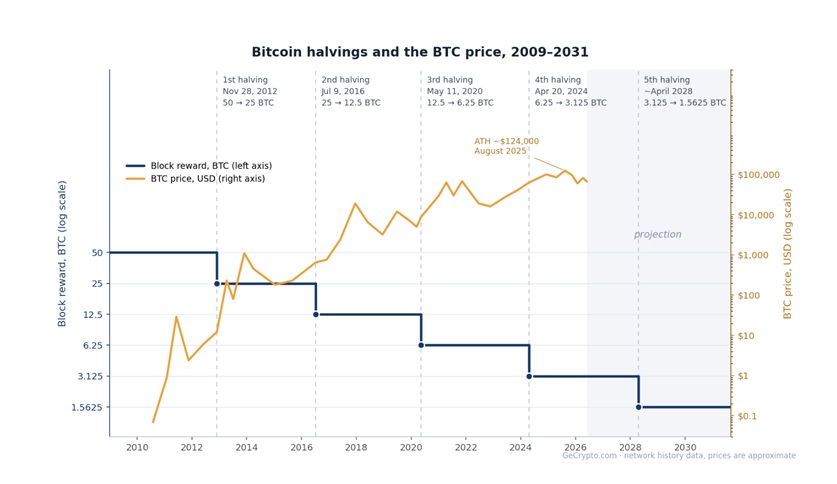
Bitcoin halvings and BTC price, 2009-2031
Bitcoin halvings and the BTC price
The pattern is hard to miss: in the twelve months following each halving, the price of bitcoin rose noticeably. The strength of the effect, however, fades from cycle to cycle. After the first halving the price grew almost 90x, after the second roughly 4x, after the third about 6.4x, and after the fourth the one-year gain came to around 35%. The larger the market becomes, the less a cut in new supply moves it.
Key dates to remember: November 28, 2012 (reward dropped from 50 to 25 BTC), July 9, 2016 (25 to 12.5 BTC), May 11, 2020 (12.5 to 6.25 BTC), and April 20, 2024 (6.25 to 3.125 BTC).
The 2024 Halving and the Current Cycle
The fourth halving took place on April 20, 2024, at block 840,000. The miner reward fell from 6.25 to 3.125 BTC, bringing daily issuance down to roughly 450 BTC. This cycle stood out from the start: for the first time, a halving coincided with a massive inflow of institutional money through spot bitcoin ETFs, approved in the United States in January 2024.
What followed broadly repeated the historical script, only with smaller amplitude. In August 2025, bitcoin set a new all-time high near $124,000. The market then entered a correction phase: in the first half of 2026, the price dipped into the $60,000 to $67,000 range. Similar drawdowns followed the peaks of previous cycles as well, which is why many analysts read the current period as a normal stage of the four-year cycle rather than proof that the cycle is broken.
For anyone assessing the 2024 halving's impact on the 2026 price, the honest summary is this: reduced issuance supported the rally to the 2025 high, but it could not shield the market from a correction driven by profit-taking and macro conditions. Halving is one input among many, never the whole story.
When Is the Next Bitcoin Halving?
The fifth halving will occur at block 1,050,000. At the current pace of block production, that points to April 2028, with estimates from different trackers ranging between March and May. The exact date will only become clear shortly before the event, since it depends on how fast the network actually mines blocks.
After the 2028 halving, the block reward will drop from 3.125 to 1.5625 BTC, and daily issuance will fall from about 450 to about 225 BTC. By then, more than 95% of all bitcoins that will ever exist will already be in circulation. The remaining coins will trickle out for more than a century: by current estimates, miners will collect the last bitcoin around the year 2140.
What the Halving Affects
Coin supply
The most direct consequence is a smaller flow of new coins to the market. If demand for bitcoin stays flat or grows while new supply is cut in half, the balance tilts toward buyers. Miners need to pay for electricity and hardware, so they regularly sell part of what they mine. After a halving, that recurring sell pressure weakens.
Miner economics and hashrate
For miners, a halving means their bitcoin-denominated revenue instantly drops by half. Operations running outdated hardware or paying high electricity rates exit the market after each halving or merge with larger players. Network difficulty can dip briefly, but hashrate has historically recovered and gone on to set new records as prices rose and equipment improved. Over time, transaction fees will make up a growing share of miner income, gradually replacing the subsidy.
The price of bitcoin
Each of the four completed halvings preceded a notable price advance over the following 12 to 18 months. This observation gave rise to the popular theory of bitcoin halving cycles: accumulation, post-halving growth, peak, correction, and a new accumulation phase. Supporters point to the recurring pattern. Skeptics counter that four events are far too small a sample for statistical confidence.
The altcoin market
Halving also ripples through the rest of the crypto market. In bitcoin's growth phase, capital usually concentrates in bitcoin first and later rotates into altcoins, producing what traders call altseason. In the 2024-2025 cycle this rotation was weaker than before: institutional investors who arrived through ETFs mostly stayed in bitcoin.
Why a Post-Halving Rally Is Not Guaranteed
Treating the halving as a promise of profit is risky, for several reasons.
First, the market knows about the halving in advance. The date is predictable within weeks, so expectations can be priced in long before the reward actually drops. When that happens, the halving itself passes without any visible market reaction.
Second, the influence of each successive halving objectively shrinks. When the reward fell from 50 to 25 BTC, the market lost half of a significant supply stream. The cut from 3.125 to 1.5625 BTC affects less than one percent of circulating supply per year. The scarcity effect still exists, but its scale bears no comparison to the early cycles.
Third, bitcoin no longer lives in isolation. Its price increasingly responds to macro forces: central bank rates, equity market trends, regulation, and ETF flows. Any of these can outweigh the halving effect in either direction. The correction in the first half of 2026 illustrates the point well: reduced issuance did not prevent the decline.
Halvings in Other Cryptocurrencies
Coins built on bitcoin's codebase use similar reward-reduction mechanisms.
Litecoin halves its block reward every 840,000 blocks, also roughly once every four years. The most recent litecoin halving took place in August 2023, and the next one is expected in the summer of 2027. Bitcoin Cash, which split from bitcoin in 2017, kept the original schedule of one halving per 210,000 blocks. Zcash runs its own emission-reduction mechanism as well.
Ethereum, by contrast, has no halving. Since the move to Proof-of-Stake in 2022, ETH issuance follows a different model: new supply depends on the amount staked, and a portion of transaction fees is burned. The phrase "Ethereum's triple halving" that circulates online referred to that one-time change in the emission model, not to a recurring event like bitcoin's.
What the Halving Means for Regular Users
If you do not mine, the halving requires nothing from you. Coins in your wallet, open positions, and exchange access remain exactly as they were. The indirect effects, though, are worth keeping in mind.
Volatility tends to climb around halvings: the price can swing sharply in both directions on expectations and headlines. Network fees also rise during periods of hype, so it pays to plan transfers ahead of peak congestion. For long-term investors, the halving serves as a convenient milestone for reading the market cycle, even if it should never be the only signal in a strategy.
For those buying or selling crypto in Georgia, the choice of platform matters in every phase of the market. GeCrypto operates as a VASP licensed by the National Bank of Georgia and provides crypto exchange services for individuals and businesses. Regulated status means transparent terms and full compliance with the law, which is worth the most precisely when markets turn turbulent.
FAQ
When was the last bitcoin halving?
April 20, 2024, at block 840,000. The block reward fell from 6.25 to 3.125 BTC.
When is the next bitcoin halving?
Around April 2028, at block 1,050,000. The reward will drop to 1.5625 BTC. The exact date depends on how fast blocks are mined.
How many halvings will there be in total?
Reductions continue until the subsidy falls below the smallest bitcoin unit (1 satoshi). The schedule allows for 32 halvings, with the last new coins arriving around 2140.
What happens when all bitcoins are mined?
Miners will keep confirming transactions, but their income will consist of fees alone. The network is designed to transition to this model gradually over many decades.
Can a halving be cancelled or delayed?
No. The rule is embedded in the protocol and does not depend on anyone's decision. Changing the emission schedule would require consensus from the overwhelming majority of network participants, which makes such a scenario practically impossible.