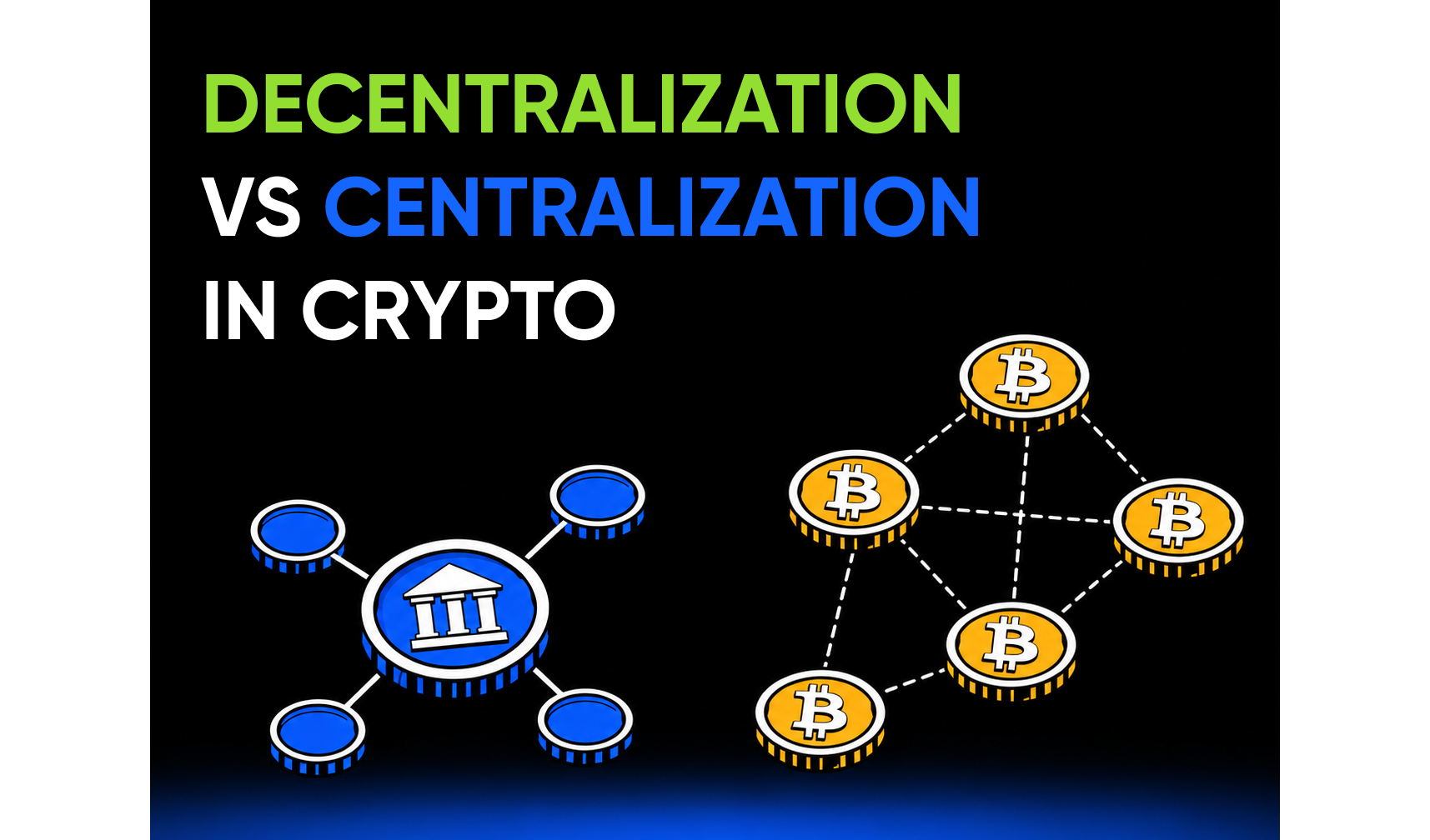
Decentralization is one of the core ideas behind crypto. Bitcoin was created as a network without a central issuer, corporate operator, or single authority controlling the rules. Over time, however, the crypto industry has grown far beyond that original model.
In 2026, the question is no longer simply whether a project “uses blockchain.” Many projects are blockchain-based, but still rely on a company, foundation, issuer, core development team, infrastructure provider, or a small group of validators. Others are much more distributed, with open participation and no single party able to change the system alone.
This distinction matters for users and investors. The level of decentralization affects censorship resistance, upgrade control, regulatory exposure, freeze risk, infrastructure resilience, and trust assumptions.
Centralization and decentralization in crypto
In crypto, centralization means that meaningful control is concentrated in the hands of a specific party. That party may be a company, a foundation, an issuer, a core development team, a group of large validators, or a small number of governance participants.
Decentralization means that control is distributed across many independent participants. These may include node operators, validators, miners, token holders, developers, and community members. In a decentralized system, no single actor should be able to unilaterally rewrite the rules, freeze assets, or control access to the network.
In practice, decentralization is best understood as a spectrum. A project may be decentralized at the network level but more centralized in governance. Another project may have distributed infrastructure but concentrated token ownership. This is why a serious assessment looks at several layers rather than relying on marketing language.
Types of centralization in crypto projects
Centralization can appear in different parts of a crypto project. A project can be strong in one area and weak in another, so it is useful to separate the main dimensions.
Technical centralization
Technical centralization concerns the infrastructure that keeps a project running. The main questions are:
How many independent nodes, validators, or miners support the network?
Does the network depend on one dominant client implementation?
Who controls oracles, bridges, APIs, and other key infrastructure?
Are there admin keys in smart contracts?
Can someone pause, upgrade, or redirect the protocol through technical access?
A recent example is Solana’s work on Firedancer, an independent validator client developed to improve client diversity. Reports in May 2026 described the beginning of Firedancer 1.0 deployment in production environments, with the main goal of reducing reliance on a single validator implementation and lowering the risk of network disruption from client-level failures.
Governance centralization
Governance centralization is about who makes decisions. A project may have a DAO, proposals, and voting tools, but decision-making can still be concentrated if most voting power sits with a foundation, early investors, or a few large token holders.
This question became especially relevant in 2026 as regulators began paying closer attention to what “real decentralization” means. Reuters reported that the U.S. Senate’s Clarity Act included criteria for decentralized finance, with platforms that fail to meet those standards potentially being treated as financial institutions subject to compliance obligations.
Economic centralization
Economic centralization refers to the distribution of tokens, stake, and financial influence. Open code does not automatically mean distributed power. If a large share of tokens or staking power is controlled by a small group, that group may have significant influence over governance, market behavior, and network security.
For Proof of Stake networks, validator diversity and stake distribution are especially important. Ethereum remains a decentralized public network, but in 2025 and 2026 the ecosystem continued to discuss liquid staking, validator concentration, client diversity, and the role of large staking providers. Lido’s Q4 2025 validator report, published in March 2026, emphasized efforts to make its Ethereum staking ecosystem more distributed across operators, infrastructure, geographies, and software implementations.
Regulatory centralization
Regulatory centralization appears when a project has a legal issuer, reserves, licenses, compliance procedures, and obligations to respond to regulators or law enforcement. This is most visible in fiat-backed stablecoins and other assets connected to traditional financial infrastructure.
USDT and USDC are widely used because they are liquid and operationally convenient. At the same time, their issuers can take compliance actions. Reuters reported in 2026 that Tether had frozen $4.2 billion worth of USDT linked to illicit activity, illustrating how a centralized stablecoin issuer can restrict token movement when required.
Stablecoins have also moved closer to traditional finance. Circle, the company behind USDC, went public in 2025, while stablecoin regulation became a major policy topic in the U.S. and other jurisdictions.
What is a centralized crypto project?
A centralized crypto project is a project where essential control remains with a specific organization or a limited group of actors. It may use blockchain, issue tokens, or interact with decentralized networks, but important decisions depend on identifiable operators.
Centralization can affect many parts of a project:
token issuance and redemption
smart contract upgrades
treasury management
access restrictions
compliance rules
infrastructure operation
product development
Centralized projects often have practical advantages. They can update products faster, provide customer support, integrate with banks and exchanges more easily, and comply with regulatory requirements. This is why many widely used crypto products remain centralized or partially centralized.
The trade-off is trust. Users depend on the operator’s decisions, legal status, security, transparency, and ability to honor obligations.
What is a decentralized crypto project?
A decentralized crypto project distributes control across a network or community. Its rules are usually embedded in the protocol, and participation is open to a broad set of independent actors.
Decentralization can involve:
public consensus rules
independent nodes or validators
open-source code
permissionless participation
transparent governance
community-driven upgrades
The practical value of decentralization is reduced dependence on one operator. A decentralized network is harder to shut down, capture, or modify for the benefit of a narrow group. It also makes arbitrary restrictions more difficult.
However, decentralization is rarely perfect. Even decentralized ecosystems can have concentrated validator influence, dominant infrastructure providers, large token holders, or a small group of core developers with significant informal power. That is why each project should be assessed by structure, not by branding.
What Is the Blockchain Trilemma and Can It Be Solved?
To understand decentralization more deeply, it is useful to know the concept of the blockchain trilemma, often associated with Ethereum co-founder Vitalik Buterin. The idea is that an ideal blockchain should combine three qualities at once: decentralization, security, and scalability, meaning the ability to process a large number of transactions efficiently.
Historically, blockchain developers have had to compromise on at least one of these three dimensions. For example, Bitcoin prioritizes decentralization and security, but it processes transactions relatively slowly compared with centralized payment systems. Many faster networks improve throughput, but they may rely on fewer validators, more centralized infrastructure, or higher hardware requirements.
This is why the trilemma matters in discussions about centralized and decentralized crypto projects. A project can be fast and convenient, but if this speed depends on a small number of validators or heavy infrastructure requirements, the network may become less decentralized in practice.
In early 2026, Vitalik Buterin argued that Ethereum had reached a practical breakthrough in this area through two technologies: PeerDAS and zkEVMs. PeerDAS, or peer data availability sampling, helps nodes verify that transaction data is available without requiring every node to download and process everything directly. zkEVMs, or zero-knowledge Ethereum Virtual Machines, allow transaction execution to be verified through cryptographic proofs rather than full re-execution by every participant.
Together, these technologies aim to increase Ethereum’s scalability without forcing the network to abandon decentralization or security. Still, it is more accurate to describe this as an important architectural milestone rather than a finished final state. The full impact depends on continued implementation, adoption, and how the network evolves over time.
How centralized and decentralized projects differ in practice
Governance and speed
Centralized projects can move quickly. A company or foundation can ship updates, adjust policies, fix bugs, and respond to regulation without waiting for broad consensus.
Decentralized projects usually move more slowly. Changes may require public discussion, voting, client updates, or coordination among many participants. The benefit is that rules are harder to change unilaterally.
The trade-off is speed versus rule stability.
User control and restrictions
Centralized projects may include mechanisms for freezing addresses, blacklisting wallets, pausing contracts, or restricting access. These tools can be used for legal compliance, fraud prevention, or sanctions enforcement.
Decentralized networks usually make direct intervention harder. Still, external restrictions can appear through exchanges, bridges, wallet providers, custodians, and fiat gateways.
Security and failure points
Centralized projects often have clear responsibility. If something goes wrong, a team can react quickly. But if the central operator or core infrastructure is compromised, the consequences can be serious.
Decentralized projects are more resistant to a single point of failure, but incident response can be slower. Fixing a serious protocol issue may require coordination across developers, validators, users, and infrastructure providers.
Regulation and fiat access
Centralized projects are easier for regulators and banks to understand. They have companies, compliance teams, legal documents, and accountable representatives.
Decentralized projects are harder to regulate directly. In practice, regulation often reaches them through infrastructure: exchanges, custodians, payment processors, wallet providers, and licensed crypto service providers.
Liquidity and usability
Centralized solutions are often easier for everyday users. They usually provide cleaner interfaces, customer support, high liquidity, and fiat integration.
Decentralized projects offer more autonomy but require more responsibility. Users must manage wallets, networks, gas fees, smart contract risk, and transaction errors themselves.
Examples of centralized and decentralized models in crypto
Bitcoin
Bitcoin remains the clearest example of a highly decentralized cryptocurrency. It has no issuer, no operating company, and no foundation that can unilaterally change ownership rules. The network is maintained by miners and nodes, and major changes require broad ecosystem agreement.
Ethereum
Ethereum is a decentralized public network with a large application ecosystem. After the move to Proof of Stake, however, decentralization analysis became more detailed. It now includes validator distribution, staking providers, client diversity, infrastructure providers, developer influence, and governance culture.
Ethereum is better assessed layer by layer rather than through a single yes-or-no label.
Stablecoins
Fiat-backed stablecoins such as USDT and USDC generally follow a more centralized model. Their stability depends on issuers, reserves, banking relationships, redemption procedures, and compliance systems.
This structure makes them useful for payments and trading, but it also introduces issuer risk and compliance-related restrictions.
DeFi protocols and DAOs
A DeFi protocol may use a DAO and governance tokens, but that alone does not guarantee strong decentralization. The real questions are:
Who holds voting power?
Are admin keys still active?
Can contracts be upgraded without broad approval?
Who controls development?
How active is the governance community?
Some DeFi projects become more decentralized over time. Others keep most practical control in the hands of a small group while presenting governance as community-driven.
Centralized exchanges and infrastructure providers
Centralized exchanges, custodians, payment services, and many infrastructure providers work with crypto, but they remain centralized businesses. They offer liquidity, convenience, customer support, and fiat access. In return, users rely on the operator’s policies, security, and compliance procedures.
How to assess whether a crypto project is decentralized
Before buying or using a project, go through a practical checklist:
Is there a legal issuer or company controlling the asset?
Who controls development and upgrades?
Is the code open and independently reviewable?
Are there admin keys or emergency powers?
Can addresses be frozen or restricted?
How are tokens distributed between the team, investors, and the market?
How concentrated are governance rights?
How many independent validators, nodes, or miners support the network?
Does the project depend on one bridge, oracle, API, hosting provider, or client implementation?
Does the project clearly explain its centralization risks?
If control can be located in one obvious place, the project is closer to the centralized end of the spectrum.
Is centralization always bad?
Centralization is not automatically a weakness. In some use cases, it brings real benefits: faster updates, user support, accountability, regulatory alignment, and easier integration with fiat infrastructure.
But centralization always adds a trust requirement. Users must trust the issuer, operator, or core team. They also accept risks related to freezes, regulatory pressure, internal governance, and operational failure.
Decentralization reduces dependence on one center of control, but it brings other challenges. Users gain more autonomy and also more responsibility. Wallet mistakes, wrong-network transfers, smart contract approvals, and protocol risks are harder to solve through customer support.
What should users or investors choose?
The right choice depends on the use case.
For payments, liquidity, speed, and fiat integration, centralized tools can be more practical. This is why stablecoins and centralized services remain widely used in trading, settlements, and cross-border payments.
For censorship resistance, long-term independence from an issuer, and predictable protocol rules, more decentralized networks may be a better fit.
The practical approach is to evaluate each project by its control layers: technology, governance, token distribution, infrastructure, and legal structure. A project should not be trusted simply because it uses the word “decentralized.”
FAQ
Are all crypto projects decentralized?
No. Many projects use blockchain technology but are still operated by a company, foundation, issuer, or small group of insiders. Blockchain usage alone does not guarantee distributed control.
Why does decentralization matter for users?
It affects freeze risk, network resilience, rule stability, and dependence on an operator. The more decentralized a project is, the harder it is for one party to change rules or restrict access.
Can a project become more decentralized over time?
Yes. Some projects begin with more centralized control and gradually distribute validators, governance rights, treasury control, and development responsibility. The important point is to verify progress through facts, not promises.
How can I quickly spot a centralized project?
Look for an issuer, admin keys, freezing powers, concentrated token ownership, dependence on one team, or reliance on one infrastructure provider. If control is easy to identify in one place, centralization is high.